
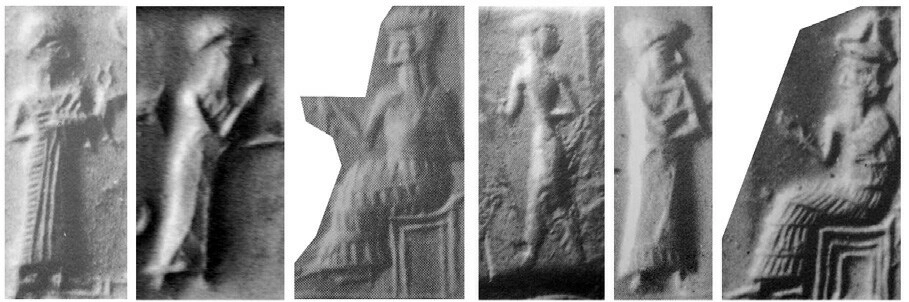

Di Ludovico A., Camiz S. 2022, Experimenting Generalized Procrustes Analysis on a corpus of scenes carved on Mesopotamian cylinder seals and encoded in a textual data set, «Archeologia e Calcolatori», 33.2, 13-32 (https://doi.org/10.19282/ac.33.2.2022.02)
Copy to clipboard Download: BibTeXExperimenting Generalized Procrustes Analysis on a corpus of scenes carved on Mesopotamian cylinder seals and encoded in a textual data set
Alessandro Di Ludovico, Sergio Camiz
«Archeologia e Calcolatori» 2022, 33.2, 13-32; doi: 10.19282/ac.33.2.2022.02
Abstract
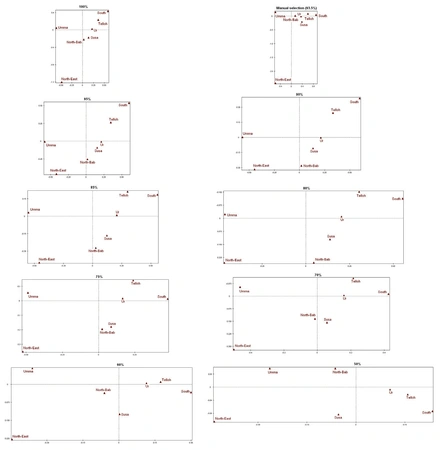
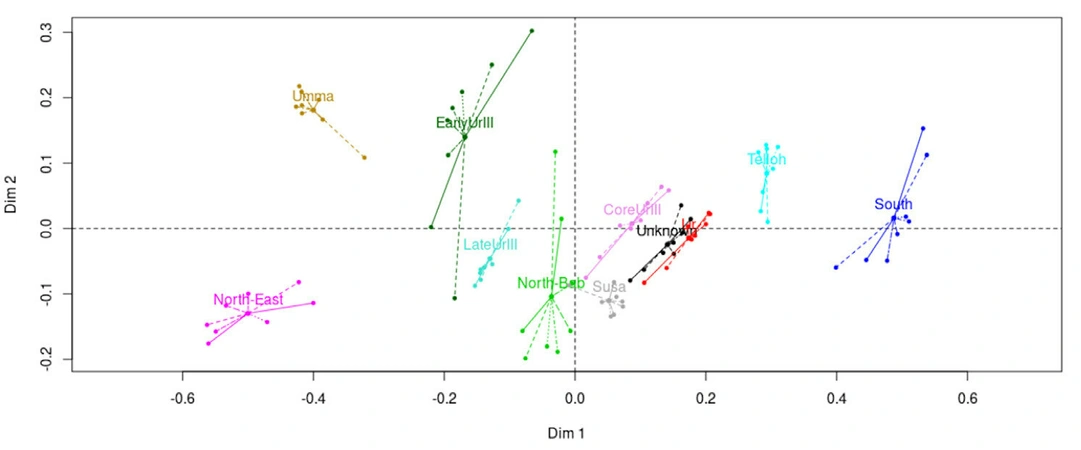
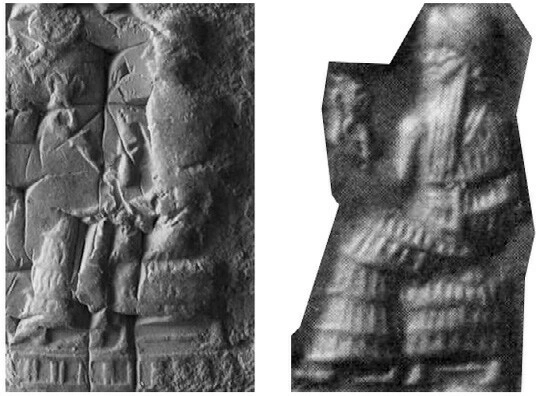
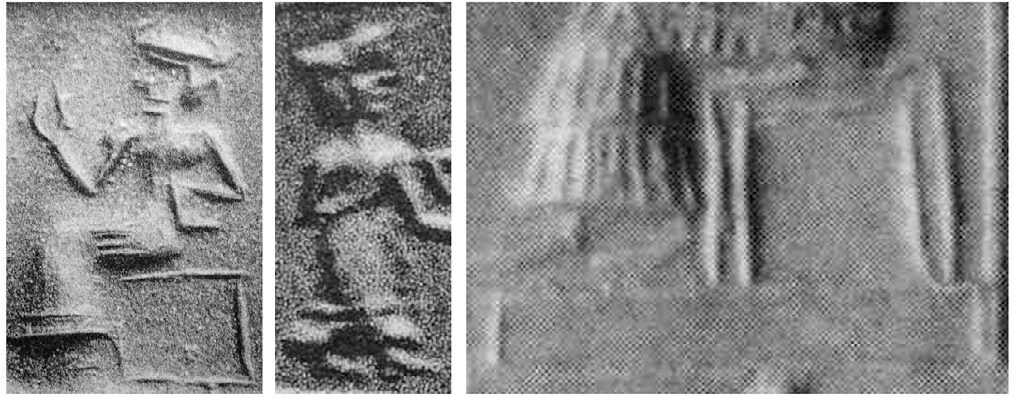
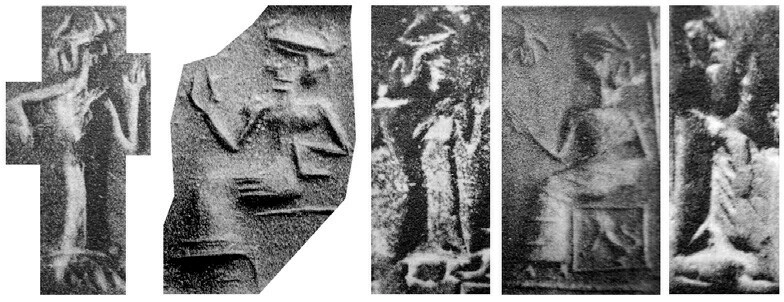
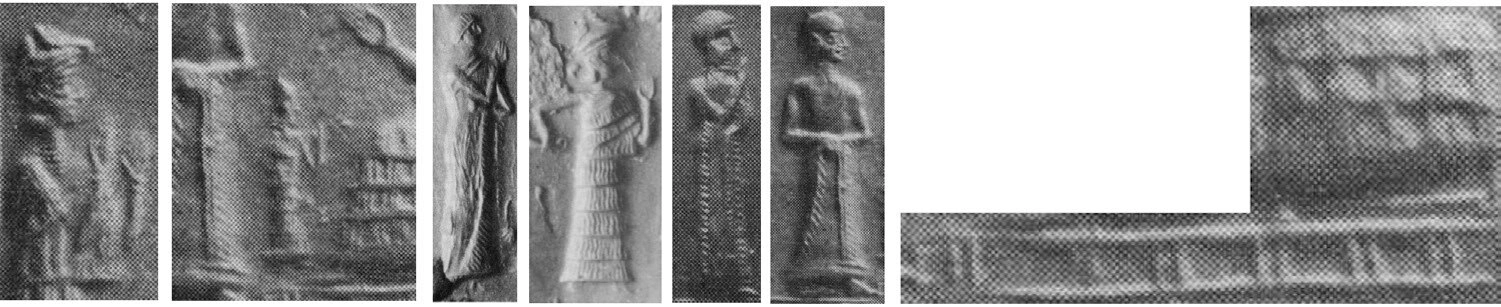
In a recently published study, a textual dataset encoding a group of scenes depicted on Mesopotamian cylinder seals from the third millennium was submitted to Procrustes Analysis, considering Correspondence Analysis variations due to progressive reductions of the forms involved. The results seemed to indicate that a slight reduction in the number of forms used to describe the raw data would improve the Correspondence Analysis results. Indeed, the actual impact of each reduction on the outcome of the analyses could not be adequately identified if the forms were not considered as elements forming segments, i.e., sub-images of the scenes. In this paper, the results of the same methodology are presented, this time applied to repeated segments within the same dataset, i.e., sequences of textual forms that may describe sub-images of the described scenes. The comparison between the progressive reductions of repeated segments showed relevant differences between small (around 10% of the rarest segments) and large reductions. Indeed, the latter may undermine a consistent interpretation of the different finding sites, yet well represented keeping 90% of segments. Moreover, a reduction performed by hand and not on the frequency of occurrences provided better results.
Figures
Preview
References
Click on the reference to open it in Bi.Di.Ar. (Bibliography of Digital Archaeology)
- Camiz S. 2004, On the coding of archaeological finds, in P. Moscati (ed.), New Frontiers of Archaeological Research. Languages, Communication, Information Technology, «Archeologia e Calcolatori», 15, 201-218 (https://doi.org/10.19282/ac.15.2004.13).
- Camiz S. 2005, The Guttman effect: Its interpretation and a new redressing method, «Tetradia Analysis Dedomenon», 5, 7-34.
- Camiz S., Rova E. 1991, Analysis of ancient Near-Eastern cylinder seals (late fourth millennium B.C.), in E. Diday, Y. Lechevallier (eds.), Symbolic-Numeric Data Analysis and Learning (Proceedings of the Conference), Commack, New York, INRIA - Nova Science Pu., 131-142.
- Camiz S., Rova E. 1996, Metodi di analisi per lo studio di un gruppo di sigilli cilindrici vicino-orientali e di altre immagini strutturate, in P. Moscati (ed.), III International Symposium on Computing and Archaeology - Roma 22-25 novembre 1995, «Archeologia e Calcolatori», 7, 647-659 (https://doi.org/10.19282/ac.7.1996.51).
- Camiz S., Rova E. 2001, Exploratory analyses of structured images: a test on different coding procedures and analysis methods, «Archeologia e Calcolatori», 12, 7-45 (https://doi.org/10.19282/ac.12.2001.01).
- Camiz S., Rova E., Tulli V. 1998, Exploratory analysis of images engraved on ancient Near-Eastern seals based on a distance among strings, «Statistica», 58, 4, 670-689 (https://doi.org/10.6092/issn.1973-2201/1114).
- Collon D. 1982, Catalogue of the Western Asiatic Seals in the British Museum. Cylinder Seals II. Akkadian, Post Akkadian, Ur III Periods, London, British Museum.
- Di Ludovico A. 2005, Scene-in-frammenti: una proposta di analisi delle “scene di presentazione” dei sigilli a cilindro mesopotamici orientata all’elaborazione statistica ed informatica dei dati, in A. Di Ludovico, D. Nadali (eds.), Studi in onore di Paolo Matthiae presentati in occasione del suo sessantacinquesimo compleanno, Contributi e Materiali di Archeologia Orientale X, Roma, Sapienza Università di Roma, 57-95.
- Di Ludovico A. 2018, Data description and the integrated study of ancient Near Eastern works of art: The potential of cylinder seals, in V. Bigot Juloux, A.R. Gansell, A. Di Ludovico (eds.), CyberResearch on the Ancient Near East and Neighboring Regions. Case Studies on Archaeological Data, Objects, Texts, and Digital Archiving, Digital Biblical Studies 2, Leiden-Boston, Brill, 85-110 (https://doi.org/10.1163/9789004375086_005).
- Di Ludovico A., Camiz S. 2014, A quantitative approach to Ur III Mesopotamian figurative languages: reflections, results, and new proposals, «Archeologia e Calcolatori», 25, 7-32 (https://doi.org/10.19282/ac.25.2014.01).
- Di Ludovico A., Camiz S. 2015, Ancient Mesopotamian glyptic products, statistics and data mining: A research proposal, in F. Giligny, F. Djindjian, L. Costa, P. Moscati, S. Robert (eds.), 21st Century Archaeology. Concepts, methods and tools, Proceedings of the 42nd Annual Conference on Computer Applications and Quantitative Methods in Archaeology CAA 2014, Oxford, Archaeopress, 489-496 (https://doi.org/10.2307/jj.15135883.60).
- Di Ludovico A., Camiz S. 2015, Art history of the ancient Near East and mathematical models. An overview, in F. Giligny, F. Djindjian, L. Costa, P. Moscati, S. Robert (eds.), 21st Century Archaeology. Concepts, methods and tools, Proceedings of the 42nd Annual Conference on Computer Applications and Quantitative Methods in Archaeology CAA 2014, Oxford, Archaeopress, 29-34 (https://doi.org/10.2307/jj.15135883.7).
- Di Ludovico A., Camiz S. 2020, Image study of Mesopotamian cylinder seals through texts: the Procrustes transformation applied to Correspondence Analysis results, «Archeologia e Calcolatori», 31, 1, 7-32 (https://doi.org/10.19282/ac.31.1.2020.01).
- Di Ludovico A., Camiz S., Pieri G. 2013, Comparative use of mathematical models in an investigation on Mesopotamian cylinder seals, in F. Contreras Cortés, M. Farjas, F.J. Melero (eds.), CAA2010: Fusion of Cultures. Proceedings of the 38th Annual Conference on Computer Applications and Quantitative Methods in Archaeology (Granada 2010), BAR International Series 2494, Oxford, Archaeopress, 495-498.
- Di Ludovico A., Ramazzotti M. 2008, Reconstructing lexicography in glyptic art: Structural relations between the Akkadian age and the Ur III Period, in R.D. Biggs, J. Myers, M.T. Roth (eds.), Proceedings of the 51st Rencontre Assyriologique Internationale (Chicago 2005), Studies in Ancient Oriental Civilization 62, Chicago, Oriental Institute Publications, 263-280.
- Gardin J.-C. 1958, Four codes for the description of artifacts: An essay in archaeological technique and theory, «American Anthropologist», 60, 2, 335-357 (https://doi.org/10.1525/aa.1958.60.2.02a00090).
- Gardin J.-C. 1966, Éléments d’un modèle pour la description des lexiques documentaires, «Bulletin des Bibliothèques de France», 5, 171-182 (https://bbf.enssib.fr/consulter/bbf-1966-05-0171-001).
- Gardin J.-C. 1967, Methods for the descriptive analysis of Archaeological Material, «American Antiquity», 32, 1, 13-30 (https://doi.org/10.2307/278775).
- Gower J.C. 1975, Generalized Procrustes analysis, «Psychometrika», 40, 1, 33-51 (https://doi.org/10.1007/BF02291478).
- Gower J.C., Dijksterhuis G.B. 2004, Procrustes Problems, Statistical Science Series 30, Oxford, Oxford University Press (https://doi.org/10.1093/acprof:oso/9780198510581.001.0001).
- Haussperger M. 1991, Die Einführungsszene. Entwicklung eines mesopotamischen Motivs von der altakkadischen bis zum Ende der altbabylonischen Zeit, Münchener Vorderasiatische Studien 11, München-Wien, Profil.
- Lebart L., Morineau A., Bécue M., Haeusler L. 1994, Spad.t – version 1.5 – Manuel de référence, Paris, CISIA.
- Lebart L., Salem A. 1988, Analyse statistique des données textuelles, Paris, Dunod.
- Lebart L., Salem A. 1994, Statistique textuelle, Paris, Dunod.
- Lê S., Josse J., Husson F. 2008, FactoMineR: An R package for multivariate analysis, «Journal of Statistical Software», 25, 1, 1-18 (https://doi.org/10.18637/jss.v025.i01).
- R Core Team 2007, R: A language and environment for statistical computing, Vienna, R Foundation for Statistical Computing (http://www.R-project.org).
- Winter I.J. 1986, The King and the cup: Iconography of the royal presentation scene on Ur III seals, in M. Kelly-Buccellati, P. Matthiae, M.N. Van Loon (eds.), Insight through Images. Studies in Honor of Edith Porada, Bibliotheca Mesopotamica 21, Malibu, Undena Publications, 253-268.
- Winter I.J. 1987, Legitimation of authority through image and legend: Seals belonging to officials in the administrative bureaucracy of the Ur III state, in M. Gibson, R.D. Biggs (eds.), The Organization of Power. Aspects of Bureaucracy in the Ancient Near East, Studies in Ancient Oriental Civilization 46, Chicago, Oriental Institute of the University of Chicago, 69-116 (https://oi.uchicago.edu/sites/oi.uchicago.edu/files/uploads/shared/docs/saoc46.pdf).
Browse
Subjects
Statistics Classification of archaeological finds
Download (PDF)Publishers
CNR - Istituto di Scienze del Patrimonio Culturale
Edizioni All'Insegna del Giglio
Places mentioned in the article
This website uses only technical cookies strictly necessary for its proper functioning. It doesn't perform any profiling and doesn't use third party cookies of any kind.
Read our privacy policy for additional information.
By clicking 'OK' or closing this banner you acknowledge having read this information and accept the website's contents.