

Esposito M. 2021, Antefixes from Museo Provinciale Campano in Capua. A proposal for a virtual reconstruction, in V. Baldoni (ed.), From pottery to context. Archaeology and virtual modelling, «Archeologia e Calcolatori», 32.2, 105-119 (https://doi.org/10.19282/ac.32.2.2021.10)
Copy to clipboard Download: BibTeXAntefixes from Museo Provinciale Campano in Capua. A proposal for a virtual reconstruction
«Archeologia e Calcolatori» 2021, 32.2, 105-119; doi: 10.19282/ac.32.2.2021.10
Abstract
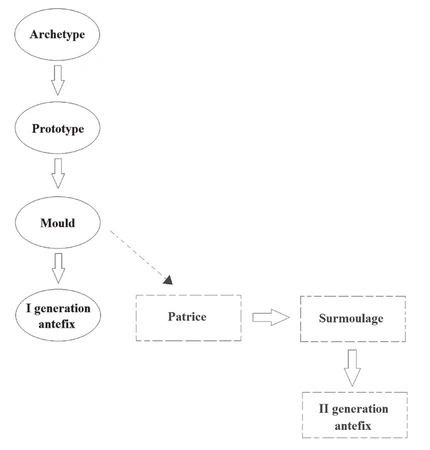
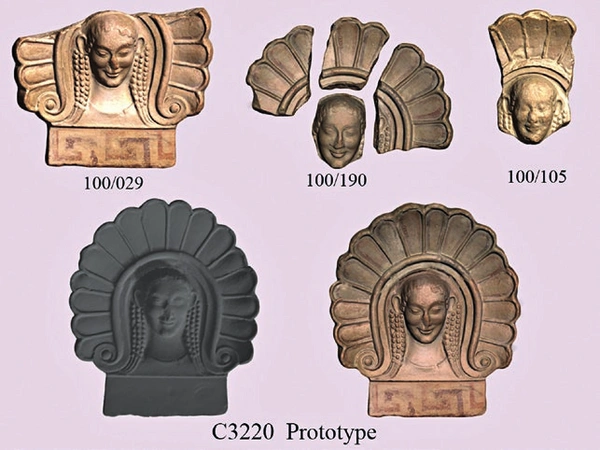
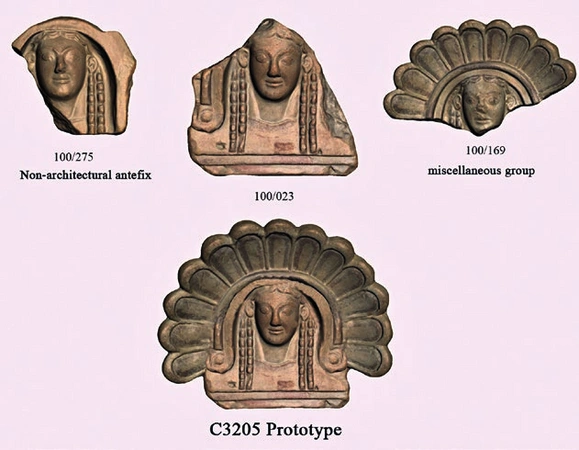
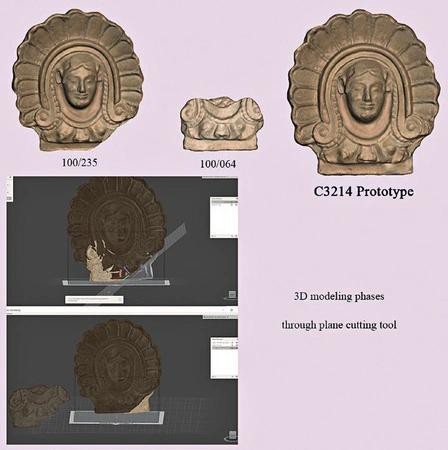
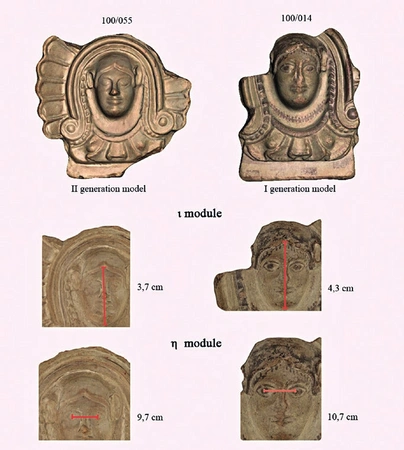
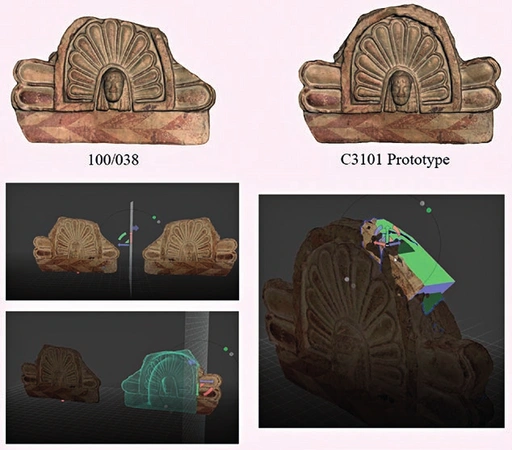
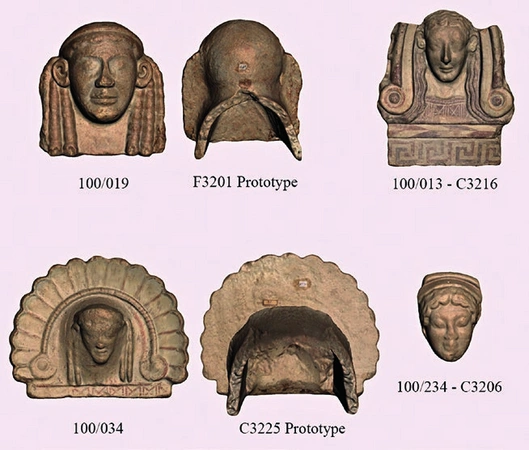
The paper aims to illustrate an intervention of digital restoration carried out on different groups of antefixes coming from excavations started in 1845 in a private fund today located in Curti, near Caserta and pertaining to sacred building roofs of a sanctuary whose oldest phase is dated to the 6th century BC. Nowadays, finds are preserved in the Museo Provinciale Campano, located in Capua. Particularly, two hundred and fifty antefixes belonging to the group named ‘female heads within the nimbus’, have been studied, articulated into thirty different series, filed in a database created ad hoc, and the digital restoration of their prototypes has been completed. Issues relating to seriality and traceability of these finds to individual archetypes will be explored, features that make a faithful 3D reconstruction of a prototype possible, based on the combination of physical data of fragmented antefixes pertaining to each series. Furthermore, phases and techniques of detection and scanning of an archaeological find using a laser scanner for small objects will be particularly analyzed. It will show how to achieve a mesh from a scanning file and how to elaborate it. Lastly, processing steps necessary to the realization of a 3D restoration will be illustrated through modeling techniques and collation of different 3D scannings. These kinds of technological experimentations contribute to diversify our memory transmission modes. They offer the chance to create digital and implementable catalogs, useful for a dynamic documentation of the Archaeological Heritage, but also and above all, fundamental tools for the monitoring, conservation and fruition of analyzed corpora.
Figures
Preview
References
Click on the reference to open it in Bi.Di.Ar. (Bibliography of Digital Archaeology)
- Bartolucci D. 2009, Principi di laser scanning 3D. Hardware, metodologie applicative, Palermo, Flaccovio.
- Bennardi D., Furferi R. 2007, Il restauro virtuale. Tra ideologia e metodologia, Firenze, Edizioni Firenze.
- Bernardini F., Rushmeier H.E. 2000, 3D Model acquisition, in Eurographics 2000. State of the Art Reports Proceedings (Interlaken 2000), Interlaken (Switzerland), Eurographics Association.
- Bianchini M. 2008, Manuale di rilievo e di documentazione digitale in archeologia, Roma, Aracne.
- Cuomo di Caprio N. 2007, Ceramica in archeologia 2. Antiche tecniche di lavorazione e moderni metodi d’indagine, Roma, L’Erma di Bretschneider.
- Gabellone F. 2010, Metodologie integrate per la conoscenza dello stato attuale e lo studio ricostruttivo dei Beni Culturali, in F. D’Andria, D. Malfitana, N. Masini, G. Scardozzi (eds.), Dialogo dei saperi. Metodologie integrate per i Beni Culturali, Napoli, Edizioni Scientifiche Italiane, 496-497.
- Gabellone F. 2019, Archeologia Virtuale. Teoria, tecniche e casi di studio, Lecce, Edizioni Gri.
- Johannowsky W. 1989, Capua antica, Napoli, Banco di Napoli.
- Kästner V. 1984, Archaische Frauenkopfantefixe aus Capua, «Forschungen und Berichte», 24, 66-74 (https://doi.org/10.2307/3880926).
- Koch H. 1912, Dachterrakotten aus Campanien mit Ausschluss von Pompeii, Berlin, Druck und Verlag von Georg Reimer.
- Limoncelli M. 2011, Applicazioni digitali per l’Archeologia: il restauro virtuale, «DigItalia. Rivista del digitale nei beni culturali», 6, 1, 42-59.
- Limoncelli M. 2012, Il restauro virtuale in archeologia, Roma, Carocci.
- Migliari R. (ed.) 2002, Frontiere del rilievo. Dalla matita alle scansioni 3D, Roma, Gangemi.
- Minervini G. 1880, Terrecotte del Museo Campano, I, II. Terrecotte di arcaico lavoro greco, Napoli, Tipografia Rondinella.
- Mingazzini P. 1938, Il santuario della dea Marica alle foci del Garigliano, «Monumenti Antichi dei Lincei», 37, 693-984.
- Peloso D. 2005, Tecniche laser scanner per il rilievo dei beni culturali, «Archeologia e Calcolatori», 16, 199-224 (https://doi.org/10.19282/ac.16.2005.11).
- Rescigno C. 1998, Tetti campani. Età arcaica: Cuma, Pitecusa e gli altri contesti, Roma, Giorgio Bretschneider.
- Rescigno C. 2009, Un bosco di madri. Capua, il santuario di fondo Patturelli tra documenti e contesti, in M.L. Chirico, R. Cioffi, S. Quilici Gigli, G. Spinazzola Pignatelli (eds.), Lungo l’Appia. Scritti su Capua antica e dintorni, Napoli, Giannini Editore, 29-40.
- Rocchini C., Cignoni P., Montani C., Pingi P., Scopigno R. 2001, A suite of tools for the management of 3D scanned data, in Italy-Canada Workshop on 3D Digital Imaging and Modeling (Padua 2001), Quebec city, Institute of Electrical and Electronics Engineers.
- Strassoldo R. 2007, Le carte del restauro. I criteri per gli interventi di recupero dei beni architettonici, Udine, Forum.
- Vaccari M.G. (ed.) 1996, La scultura in terracotta: tecniche e conservazione, Firenze, Centro Di.
- Winter N.A. 1978, Archaic architectural terracottas decorated with human heads, «Mitteilungen des Deutschen Archäologischen Instituts, Römische Abteilung», 85, 27-58.
- Winter N.A. 1993, Greek Architectural Terracottas, from the Prehistoric to the End of the Archaic Period, Oxford, Clarendon Press (https://doi.org/10.1093/oso/9780198147947.001.0001).
Browse
Subjects
Virtual Reality and 3D Modelling Classification of archaeological finds
Download (PDF)Publishers
CNR - Istituto di Scienze del Patrimonio Culturale
Edizioni All'Insegna del Giglio
Places mentioned in the article
This website uses only technical cookies strictly necessary for its proper functioning. It doesn't perform any profiling and doesn't use third party cookies of any kind.
Read our privacy policy for additional information.
By clicking 'OK' or closing this banner you acknowledge having read this information and accept the website's contents.