
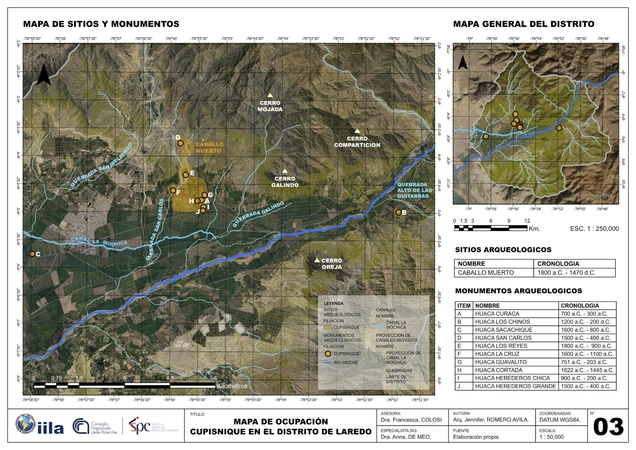
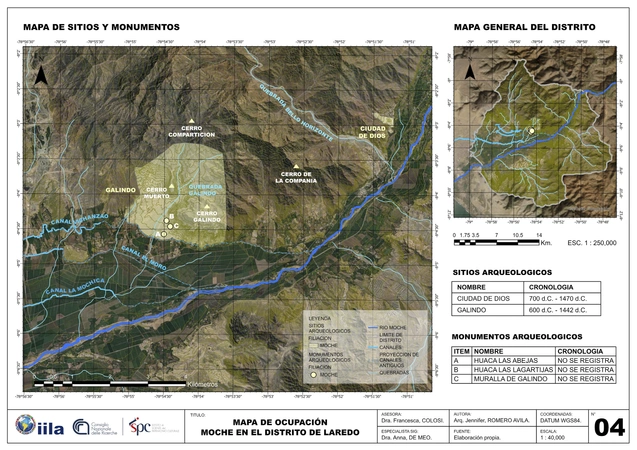
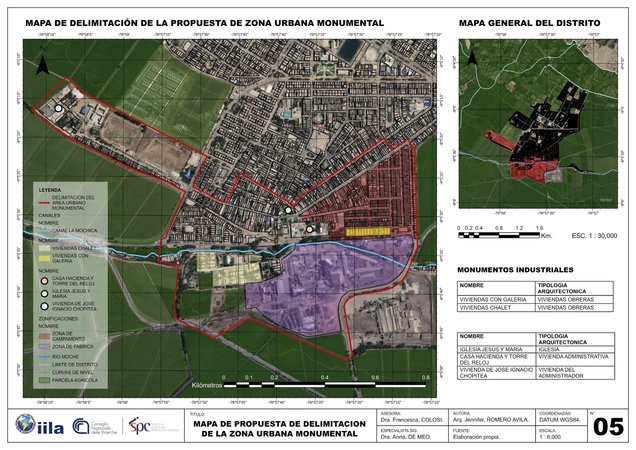
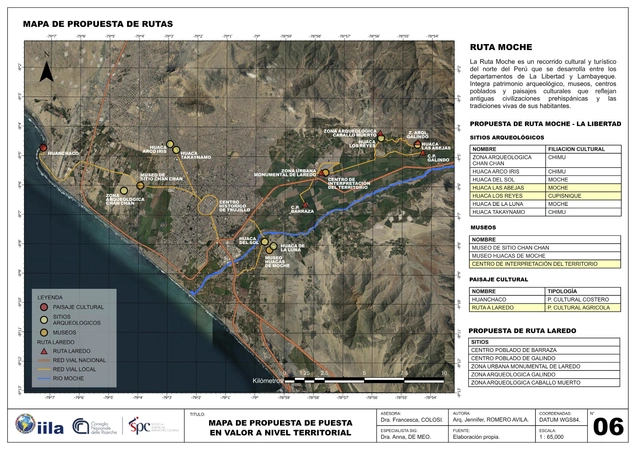

Romero Ávila J., Colosi F., De Meo A. 2026, Análisis multiescalar para el estudio y la valorización del patrimonio territorial y monumental: el GIS del Distrito de Laredo, Valle del Moche (Perú), «Archeologia e Calcolatori», 37.1, 51-72 (https://doi.org/10.19282/ac.37.1.2026.03)
Copy to clipboard Download: BibTeXAnálisis multiescalar para el estudio y la valorización del patrimonio territorial y monumental: el GIS del Distrito de Laredo, Valle del Moche (Perú)
Jennifer Romero Ávila, Francesca Colosi, Anna De Meo
«Archeologia e Calcolatori» 2026, 37.1, 51-72; doi: 10.19282/ac.37.1.2026.03
Abstract
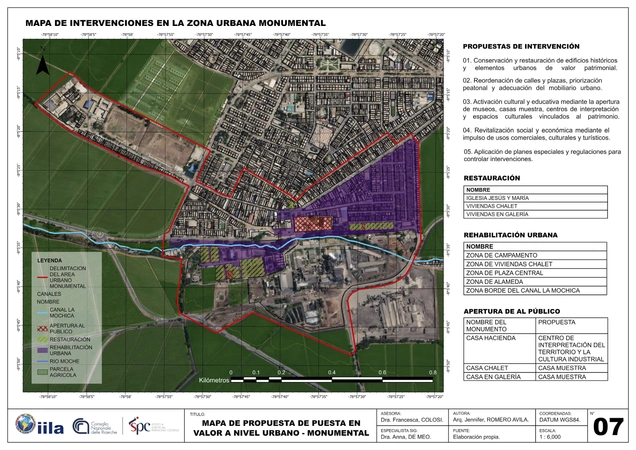
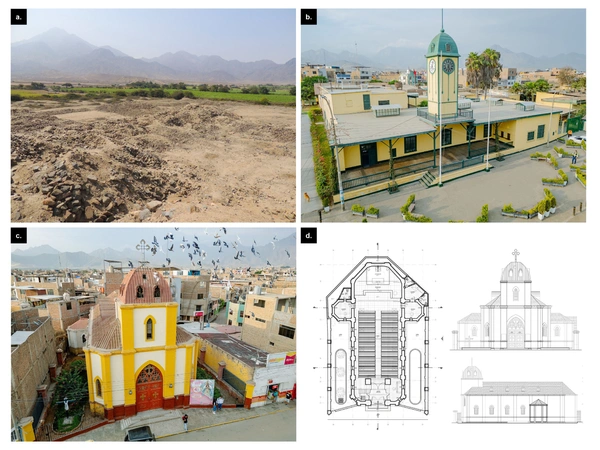
The district of Laredo is located in the middle valley of the Moche River, along the northern coast of Peru, near the city of Trujillo. Since pre-Hispanic times, this area has been characterized by continuous processes of occupation, documented through irrigation systems, monumental earthen architecture, and road networks connecting the valley with inland regions. Today, these archaeological remains coexist with agricultural landscapes of colonial origin, industrial infrastructures linked to sugar production and contemporary settlements, forming a complex and stratified cultural landscape that remains little known and undervalued. This territorial heritage can be fully understood only when considered as a whole and analyzed through a multiscale approach – territorial, urban, and architectural. The research is based on the development of a GIS platform designed to integrate, manage, and analyze environmental, archaeological, and architectural geo-datasets at different spatial scales. The GIS-supported spatial analyses made it possible to reconstruct settlement dynamics from the Lithic Period to the modern era, to explore relationships between sites, infrastructures, and environmental factors, and to define criteria for the sustainable management and enhancement of the historical landscape and earthen heritage of the middle Moche Valley.
Figures
Preview
References
Click on the reference to open it in Bi.Di.Ar. (Bibliography of Digital Archaeology)
- Barazzetti L., Roncoroni F. 2021, Generation of a multi-scale historic BIM-GIS with digital tools: The complex of San Pietro al Monte in Civate (Italy), «Heritage», 4, 4, 185 (https://doi.org/10.3390/heritage4040185).
- Bawden G. 1978, Life in the pre-Columbian town Galindo, «Field Museum of Natural History Bulletin», 3, 16-23.
- Bawden G. 1982, Galindo: A study in cultural transition during the Middle Horizon, in M.E. Moseley, K.C. Day (eds.), Chan Chan: Andean desert city, Albuquerque, University of New Mexico Press, 285-320.
- Bawden G. 1990, Domestic space and social structure in Pre-Columbian Northern Peru, in S. Kent (ed.), Domestic Architecture and the Use of Space, New York, Cambridge University Press, 153-171.
- Bazán Ramírez F. 2021, Laredo en el tiempo. Watanabe e identidad, Trujillo, Trotamundos.
- Berrocal Neciosup L. 2003, Laredo. De hacienda a ciudad, Trujillo, Desarrollo y vida Editores.
- Billman B. 2002, Irrigation and the origins of the southern Moche state on the north coast of Peru, «Latin American Antiquity», 13, 4, 371-400 (https://doi.org/10.2307/972222).
- Bortolotto C., Skounti A. (eds.) 2024, Intangible Cultural Heritage and Sustainable Development: Inside a UNESCO Convention, London-New York, Routledge (https://doi.org/10.4324/9781003244158).
- Briceño Rosario J. 2011, Últimos descubrimientos del paijanense en la parte alta de los valles de Chicama, Moche y Virú, norte del Perú: nuevas perspectivas sobre los primeros cazadores-recolectores en los andes de Sudamérica, «Boletín de arqueología PUCP», 15, 165-203 (https://doi.org/10.18800/boletindearqueologiapucp.201101.007).
- Briceño Rosario J., Billman B. 2018, Cerro León y la ocupación rural serrana antes de la formación del estado moche, parte media del valle de Moche, «Quingnam», 4, 77-150 (https://doi.org/10.22497/quingnam.04.0403).
- Campana Delgado C. 2006, Chan Chan del Chimo. Estudio de la ciudad de adobe más grande de América Latina, Lima, Editorial Orus.
- Canziani Amico J. 2021, Paisajes culturales y desarrollo territorial en el Perú, Lima, Fondo editorial de la Pontificia Universidad Católica del Perú.
- Chauchat C., Guffroy J. 2003, Sepulturas intrusivas Salinar y Chimú en la huaca Herederos Chica, valle de Moche, Perú, «Bulletin de l’Institut français d’études andines», 32, 2, 215-293 (https://doi.org/10.4000/bifea.6204).
- Colosi F., Bacigalupo C., De Meo A., Kobata Alva S.A., Orazi R., Rojas Vasques G.E., León Trujillo F.J. 2025, Chan Chan (Perú), la ciudad de tierra. La amenaza al paisaje cultural de un sitio Patrimonio Mundial, «ACE: Architecture, City and Environment», 20, 58 (https://doi.org/10.5821/ace.20.58.12658).
- Colosi F., Gabrielli R., Orazi R., Malinverni E.S. 2013, Discovering Chan Chan: modern technologies for urban and architectural analysis, «Archeologia e Calcolatori», 24, 187-207 (https://doi.org/10.19282/ac.24.2013.09).
- Colosi F., Malinverni E.S., León Trujillo F.J., Pierdicca R., Orazi R., Di Stefano F. 2022, Exploiting HBIM for historical mud architecture: The huaca Arco Iris in Chan Chan (Peru), «Heritage», 5, 2062-2082 (https://doi.org/10.3390/heritage5030108).
- Colosi F., Mora L., Orazi R. 2019, Palacio Rivero en Chan Chan: levantamiento UAV y análisis arquitectónico, «SIAN. Revista arqueológica», 24, 30, 1-20.
- Convenzione per la salvaguardia del patrimonio culturale immateriale 2003, Paris, UNESCO.
- Corcuera Cueva V.D. 2016, Zona arqueológica quebrada Santo Domingo, valle de Moche, La Libertad. 17 años de su defensa y protección, «Boletín APAR», 7, 1127-1152 (https://doi.org/10.70748/ba.24.2016.188).
- Corcuera Cueva V.D. 2018, Los balsares de Huanchaco: Un sitio Ramsar en La Libertad, Perú, «Pueblo Continente», 29, 449-463.
- Cruz Rodríguez G. 2022, Filiación cultural y función del sitio arqueológico Cerro Compañía, valle medio de Moche, Tesis de licenciatura, Universidad Nacional de Trujillo.
- Cultural Landscapes 2010, Paris, UNESCO.
- Del Carpio Perla M., Rucabado Yong J., Mac Kay Fulle M. 2024, Chamanes en el arte rupestre: el caso del Alto de las Guitarras en la costa norte del Perú, «En líneas generales», 11, 54-73 (https://doi.org/10.26439/en.lineas.generales2024.n011.7370).
- Fernández Cacho S. 2023, Cultural landscapes inventories: Theories, methods and techniques, «ACE: Architecture, City and Environment», 17, 51 (https://doi.org/10.5821/ace.17.51.11807).
- Gamarra N., Rengifo C. 2020, Chan Chan y la cultura Chimú. Marco general de las investigaciones del PECACH, in C. Rengifo (ed.), Chan Chan: esplendor y legado. Redescubriendo la antigua capital del Chimor, Trujillo, Gráfica Fénix S.R.L., 17-45.
- Gamboa Velásquez J., Nesbitt J. 2012, La ocupación Moche en la margen norte del valle bajo de Moche, costa norte del Perú, «Arqueología y Sociedad», 25, 115-142 (https://doi.org/10.15381/arqueolsoc.2012n25.e12357).
- Gumerman G.J., Briceño Rosario J. 2003, Santa Rosa-Quirihuac y Ciudad de Dios: asentamientos rurales en la parte media del valle de Moche, in S. Uceda, E. Mujica (eds.), Moche: hacia el final del milenio. Actas del Segundo Coloquio sobre la Cultura Moche (Trujillo 1999), 1, Lima, Universidad Nacional de Trujillo y Pontificia Universidad Católica del Perú, 217-243.
- Jiang N. 2021, Thematic cartography, in J.Z. Wang, F. Wu (eds.), Advances in Cartography and Geographic Information Engineering, Singapore, Springer, 213-249 (https://doi.org/10.1007/978-981-16-0614-4).
- Liu B., Wu C., Xu W., Shen Y., Tang F. 2024, Emerging trends in GIS application on cultural heritage conservation: A review, «Heritage Science», 12, 139, 1-14 (https://doi.org/10.1186/s40494-024-01265-7).
- Lockard G.D. 2009, The occupational history of Galindo, Moche valley, Perú, «Latin American Antiquity», 20, 2, 279-302 (https://doi.org/10.2307/40650196).
- López-Ortiz E., García Jiménez I., Dong J., Pineda P. 2025, A multi-scale stratigraphic HBIM-GIS method for the characterization of structures in heritage sites, «Journal of Cultural Heritage», 76, 352-372 (https://doi.org/10.1016/j.culher.2025.10.015).
- Makhloufi L. (ed.) 2024, Tangible and Intangible Heritage in the Age of Globalisation, Cambridge, Open Book Publishers (https://doi.org/10.11647/OBP.0388).
- Manfredi L.-I., Merola P., Cecalupo C., Dekayir A., Ouchaou B., Bokbot Y., Seghir M., Festuccia S., Repola L., Cozzolino M., Gentile V., Bounajma H. 2020, Integrated multi scale archaeological analysis in Béni Mellal-Khenifra District (Morocco). The case of the fortress of Ighram Aousser, «Archeologia e Calcolatori», 31, 1, 97-120 (https://doi.org/10.19282/ac.31.1.2020.05).
- Martínez Compañón B.J. 2015, Truxillo del Peru, Edición digital de mapas históricos del siglo XVIII, Alicante, Biblioteca Virtual Miguel de Cervantes.
- Moseley M.E., Day K.C. (eds.) 1982, Chan Chan: Andean desert city, Albuquerque, University of New Mexico Press (https://doi.org/10.2307/2801451).
- Núñez A. 1986, Petroglifos del Perú. Panorama Mundial del Arte Rupestre, 2, La Habana, Editorial Científico-Técnica.
- Ordenanza regional que declara la Ruta Moche eje turístico regional 2016, Trujillo.
- Ossa P.P., Moseley M.E. 1972, La Cumbre, a preliminary report on research into the early lithic occupation of the Moche valley, Peru, «Ñawpa Pacha», 9, 1-16 (https://doi.org/10.1179/naw.1971.9.1.001).
- Pettenati G. (ed.) 2023, Landscape as Heritage: International Critical Perspectives, London-New York, Routledge (https://doi.org/10.4324/9781003195238).
- Pineda Quevedo J. 2019, El ordenamiento del territorio en el valle de Moche. Lectura espacial de la vida de las sociedades prehispánicas, Lima, Universidad Nacional de Ingeniería.
- Plan de acción Ente Gestor 2008, La ruta Moche La Libertad, Trujillo (http://www.mincetur.gob.pe/newweb/portals/0/PA_Ruta_Moche.pdf).
- Pozorski T. 1980, The early Horizon site of Huaca de los Reyes: Societal implications, «American Antiquity», 45, 1, 100-110 (https://doi.org/10.2307/279663).
- Prieto G. 2016, Balsas de totora en la costa norte del Perú: una aproximación etnográfica y arqueológica, «Quingnam», 2, 141-188.
- Prieto G. 2023, Creando el Valle de Chimor: reconsideraciones y estudios preliminares de la megainfraestructura Chimú en los alrededores de Chan Chan (siglos XI y XV d.C.), «Chungara Revista de Antropología Chilena», 55, 3, 435-461 (https://doi.org/10.4067/s0717-73562023005001401).
- Prieto G., Maquera E. 2015, La arquitectura del sitio del periodo inicial de Menocucho: valle de Moche, costa norte del Perú. Uso de fotogrametría para el registro arqueológico. Alcances y potenciales, «Arkinka», 231, 92-101.
- Report of the Expert Group on Cultural Landscapes La Petite Pierre (France), 24-26 October 1992 1992, Paris, UNESCO (https://whc.unesco.org/archive/pierre92.htm).
- Rodríguez Suy Suy V.A. 1991, Uso prehispánico del agua de consumo humano en el valle de Moche, in Servicio de Agua Potable y Alcantarillado de Trujillo (ed.), El agua de la ciudad de Trujillo. Historia de su abastecimiento, Trujillo, Normas Legales S.A., 37-40.
- Thomas A. 2016, La quebrada Santo Domingo ou l’hémorragie culturelle, «Boletín APAR», 7, 1153-1158 (https://doi.org/10.70748/ba.24.2016.189).
- Uceda Castillo S., Morales Gamarra R. (eds.) 2010, Moche: pasado y presente, Trujillo, Universidad Nacional de Trujillo.
- Uceda Castillo S., Morales Gamarra R., Mujica Barreda E. 2016, Huaca de la Luna: Templos y Dioses Moches/Moche Temples and Gods, Lima, World Monuments Fund Perú-Fundación Backus.
- Ugalde García J., Bourget S. (eds.) 2013, El Templo Viejo de Huaca de la Luna, Trujillo, Proyecto Arqueológico Huacas de Moche.
- Vega Cárdenas M.A., Vega Cárdenas C.A. 1991, Historia del abastecimiento de agua a la ciudad de Trujillo Perú, in Servicio de Agua Potable y Alcantarillado de Trujillo (ed.), El agua de la ciudad de Trujillo. Historia de su abastecimiento, Trujillo, Normas Legales S.A., 81-202.
- Velásquez Benites O. 1998, Reto final del agro azucarero peruano, Trujillo, Universidad Nacional de Trujillo.
Browse
Subjects
GIS and cartography Survey and excavations
Download (PDF)Publishers
CNR - Istituto di Scienze del Patrimonio Culturale
Edizioni All'Insegna del Giglio
Places mentioned in the article
This website uses only technical cookies strictly necessary for its proper functioning. It doesn't perform any profiling and doesn't use third party cookies of any kind.
Read our privacy policy for additional information.
By clicking 'OK' or closing this banner you acknowledge having read this information and accept the website's contents.