

Di Franco L. 2025, Il paesaggio agrario di Acerrae e Suessula: il sistema delle ville rustiche, in R. Brancato, V. Ferrari, I. Rossi (eds.), Investigating Resilient Roman Agricultural Landscapes in Southern Italy. An integrated and open IT approach for archaeological topography of centuriation. Proceedings of the final conference of the PRIN 2022 project ‘In.Res.Agri’ (Naples, 20th-21st November 2025), «Archeologia e Calcolatori», 36.2, 225-246 (https://doi.org/10.19282/ac.36.2.2025.18)
Copy to clipboard Download: BibTeXIl paesaggio agrario di Acerrae e Suessula: il sistema delle ville rustiche
«Archeologia e Calcolatori» 2025, 36.2, 225-246; doi: 10.19282/ac.36.2.2025.18
Abstract
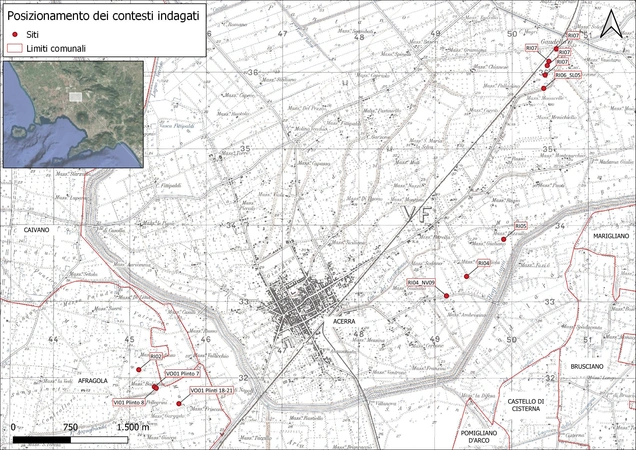
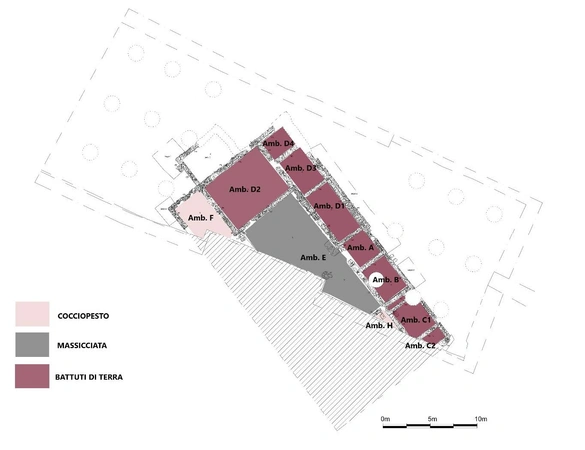
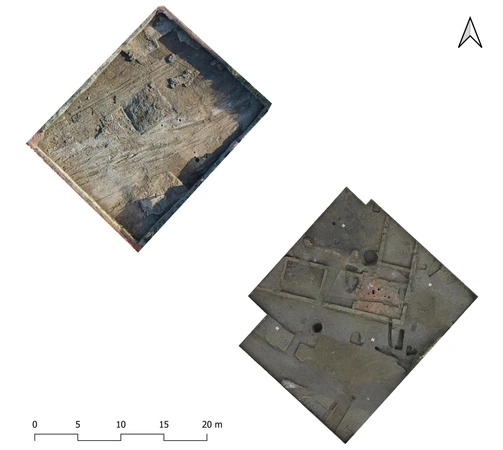
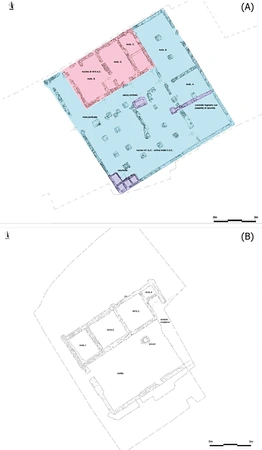
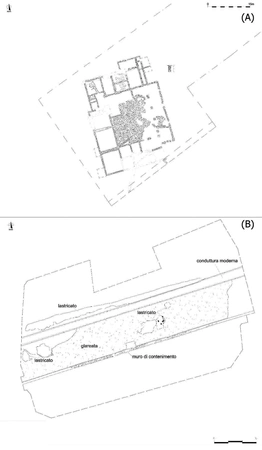
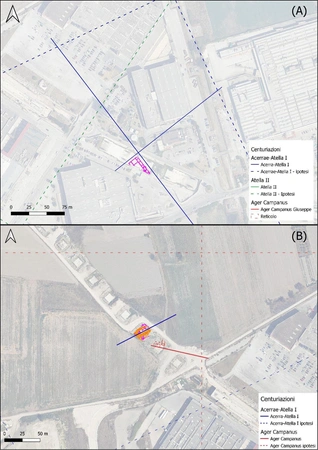
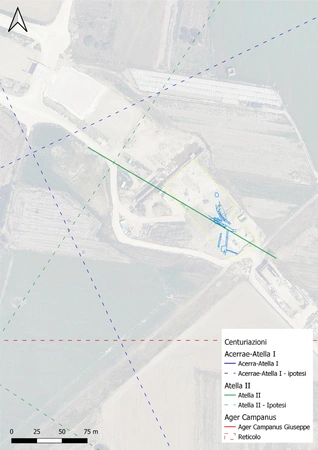
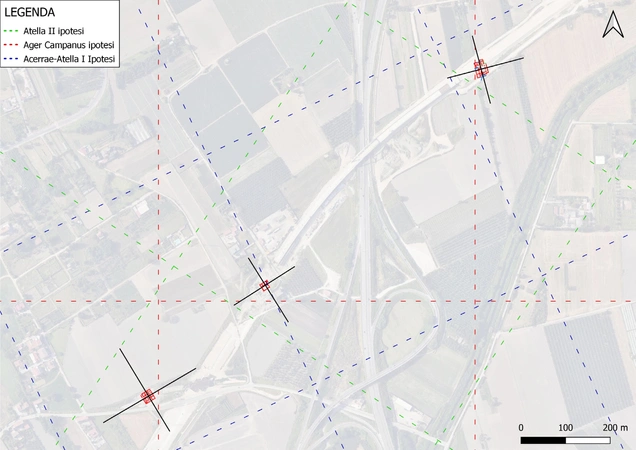
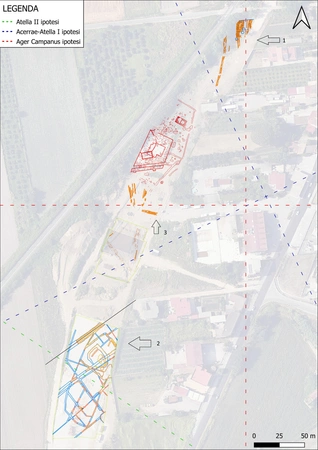
The fertile plain of Acerra, within the Campania Felix, has yielded significant new data from the preventive excavations carried out along the Naples-Bari high-speed railway. The discoveries – mainly rustic villas and related agrarian structures – provide an unprecedented picture of the rural organisation between Acerrae, Suessula, and Atella. These settlements, dating from the late Republican to the early Imperial period and often lasting until Late Antiquity, illustrate the intensive agricultural exploitation of the area through integrated systems of villas, drainage canals, roads, and centuriations. Stratigraphic and spatial analyses reveal the coexistence of different cadastral grids, particularly the ‘Acerrae-Atella I’ and ‘Ager Campanus’ systems, testifying to successive phases of Roman territorial planning. The villas, later abandoned and reused as burial areas after the 4th century AD, mark the transformation of the rural landscape in response to broader socio-economic and political changes in the Roman Empire.
Figures
Preview
References
Click on the reference to open it in Bi.Di.Ar. (Bibliography of Digital Archaeology)
- Amato V., Bonaudo R., Rossi A. 2020, La città e il suo fiume nella Campania antica: condizionamenti geomorfologici e adattamenti urbanistici delle città romane lungo la valle del Clanis, in M.T. D’Alessio, M.C. Marchetti (eds.), Rac in Rome, Atti della 12a Roman Archaeology Conference (2016), Roma, Quasar, 95-108.
- Benassai R. 2001, La pittura dei Campani e dei Sanniti, Roma, L’Erma di Bretschneider.
- Brancato R., Ferrari V., Ditaranto I., Merola P., Rossi I. 2024, Investigating resilient Roman agricultural landscapes in southern Italy. An integrated and open IT approach to modeling centuriation, in R. Brancato, J. Bogdani, V. Vitale (eds.), Linking Pasts and Sharing Knowledge. Mapping Archaeological Heritage, Legacy Data Integration and Web Technologies for Modelling Historical Landscapes (Naples 2023), «Archeologia e Calcolatori», 35, 2, 387-400 (https://doi.org/10.19282/ac.35.2.2024.41).
- Brancato R., Kay S. 2024, Legacy GIS data integration and non-invasive survey for the study of the archaeological landscape of Atella (Caserta, Campania, Italy), «GROMA: Documenting Archaeology», 9, 1, 31-56 (https://doi.org/10.32028/Groma-Issue-9-2024-3237).
- Calandra E. 2022, Il Geoportale Nazionale per l’Archeologia, in L’archeologia preventiva nel quadro del recovery plan, Roma, Accademia Nazionale dei Lincei, 71-77 (https://doi.org/10.60974/GNA_01).
- Camardo D., Carsana V., Rossi A. 2003, Suessula tra tardo-antico e medioevo, in R. Fiorillo, P. Peduto (eds.), Atti del III Congresso Nazionale di Archeologia Medievale (Salerno 2003), Firenze, All’Insegna del Giglio, 362-370.
- Camardo D., Rossi A. 2005, Suessula: trasformazione e fine di una città, in G. Vitolo (ed.), Le città campane fra tarda Antichità e alto Medioevo, Salerno, Laveglia, 167-192.
- Chouquer G., Clavel Levêque M., Favory F., Vallat J.-P. 1987, Structures agraires en Italie centro-méridionale. Cadastres et paysage ruraux, Roma, Ecole Française.
- Di Franco L. 2025, Abitare la Piana Campana in età tardoantica: ville rustiche nel territorio di Afragola, in M. Cavalieri, A. Castrorao Barba, C. Sfameni (eds.), La villa dopo la villa, 3, Louvain, Presses Universitaires de Louvain, 13-32.
- Esposito D. 2020, Le villae rusticae nella Piana del Sarno, in A. Anguissola, M. Iadanza, R. Olivito (eds.), Paesaggi domestici: l’esperienza della natura nelle case e nelle ville romane: Pompei, Ercolano e l’area vesuviana, Atti del Convegno (Pompei 2017), Roma, L’Erma di Bretschneider, 25-38.
- Esposito D. 2021, Le villae rusticae nella piana del Sarno: considerazioni sulla cronologia, in A. Coralini (ed.), Extra moenia. Abitare il territorio della regione vesuviana, Roma, Scienze e Lettere, 89-102.
- Giampaola D. 1997, Appunti per la storia del paesaggio agrario di Acerra, in S. Quilici Gigli (ed.), Uomo, acqua e paesaggio, Atti del Convegno (Santa Maria Capua Vetere 1996), Roma, L’Erma di Bretschneider, 225-238.
- Monaco M., Clavel Levêque M. 2004, Analyse spatiale, archéologie des paysages et centuriation, application des méthodes. La reconstitution d’un paysage antique: l’ager Campanus, «Dialogues d’histoire ancienne», 30, 1, 186-200.
- Papini M. 2004, “Munera gladiatoria” e “venationes” nel mondo delle immagini, Roma, Accademia Nazionale dei Lincei.
- Quilici Gigli S. 2025, Il difficile ordine dell’ager Campanus, «Atlante Tematico di Topografia Antica», 35, 291-310.
- Rescigno C., Senatore F. 2009, Le città della piana campana tra IV e III sec. a.C.: dati storici e topografici, in M. Osanna, E. Curti (eds.), Verso la città. Forme insediative in Lucania e nel mondo italico fra IV e III sec. a.C., Atti delle Giornate di Studio (Venosa 2006), Venosa, Osanna Edizioni, 415-462.
- Rossi A. 2011, Ritornando su K.J. Beloch: riflessioni sull’antica Suessula e sul suo territorio, in F. Senatore (ed.), Karl Julius Beloch. Da “Sorrento nell’antichità” alla “Campania”, Atti del Convegno (Piano di Sorrento 2009), Roma, Scienze e Lettere, 303-331.
- Ruffo F. 2010, La Campania antica. Appunti di storia e di topografia, Napoli, Denaro.
Browse
Subjects
GIS and cartography Survey and excavations
Download (PDF)Publishers
CNR - Istituto di Scienze del Patrimonio Culturale
Edizioni All'Insegna del Giglio
Places mentioned in the article
This website uses only technical cookies strictly necessary for its proper functioning. It doesn't perform any profiling and doesn't use third party cookies of any kind.
Read our privacy policy for additional information.
By clicking 'OK' or closing this banner you acknowledge having read this information and accept the website's contents.