
Brancato R., Tosolini M., Russo Ermolli E. 2025, Interaction between natural dynamics and human settlements in the territory of Gricignano d’Aversa (CE) from the Neolithic to the Roman age, in R. Brancato, V. Ferrari, I. Rossi (eds.), Investigating Resilient Roman Agricultural Landscapes in Southern Italy. An integrated and open IT approach for archaeological topography of centuriation. Proceedings of the final conference of the PRIN 2022 project ‘In.Res.Agri’ (Naples, 20th-21st November 2025), «Archeologia e Calcolatori», 36.2, 215-224 (https://doi.org/10.19282/ac.36.2.2025.17)
Copy to clipboard Download: BibTeXInteraction between natural dynamics and human settlements in the territory of Gricignano d’Aversa (CE) from the Neolithic to the Roman age
Rodolfo Brancato, Marta Tosolini, Elda Russo Ermolli
«Archeologia e Calcolatori» 2025, 36.2, 215-224; doi: 10.19282/ac.36.2.2025.17
Abstract
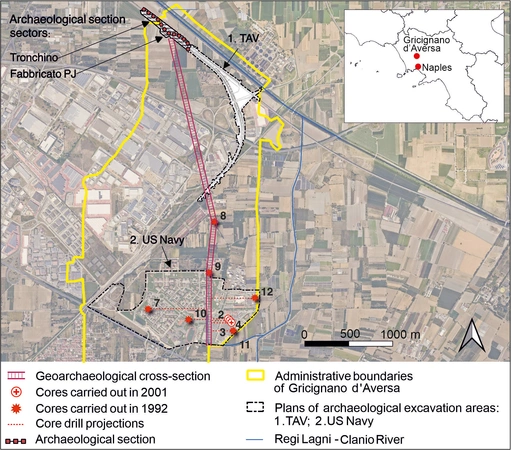
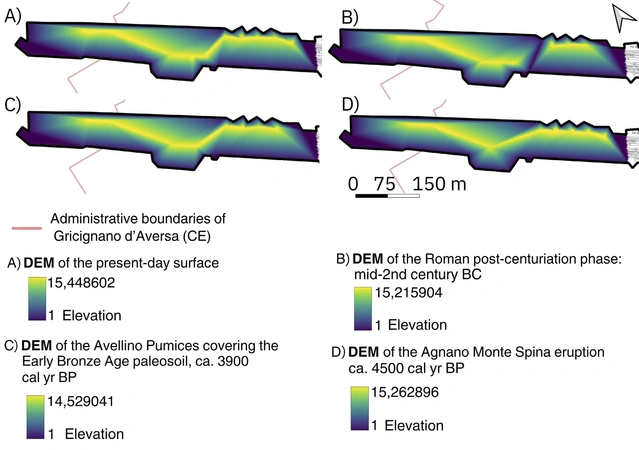
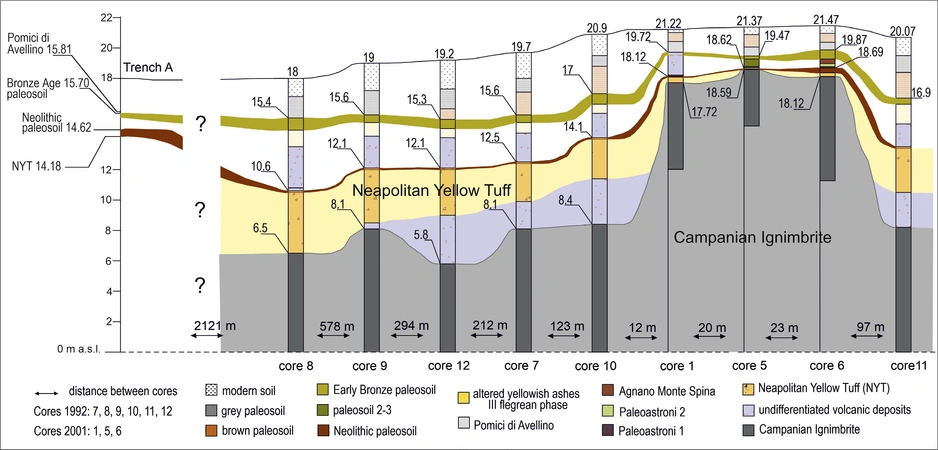
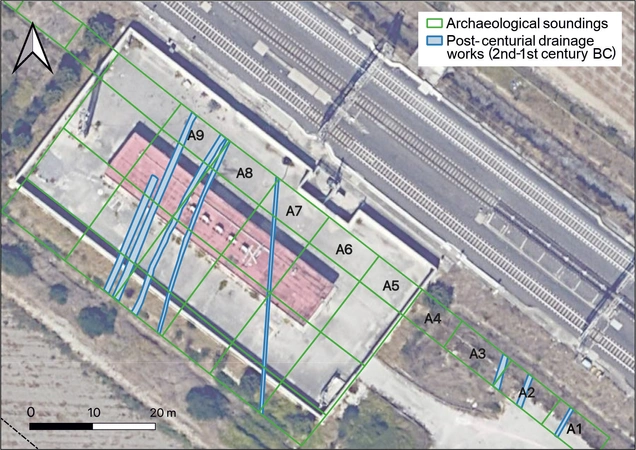
This study aims to reconstruct the long-term interactions between humans and the environment in the northern sector of Gricignano d’Aversa (CE), using historical data integrated into a Geographic Information System (GIS). Legacy data from the Archaeological Museum of Naples were digitized as part of a project involving the National Geoportal and the development of a Territorial Information System (TIS). The latter is primarily based on the elevations of stratigraphic units, georeferenced in QGIS. The soil elevation data were obtained from both archaeological and geological surveys. These data sets allowed the development of a geoarchaeological section, created with AutoCAD, as well as Digital Elevation Models (DEMs) generated with QGIS. The results show that the site’s geomorphology was mainly shaped by volcanic events, first the Campanian Ignimbrite eruption (39,000 years ago), which had a strong impact on settlement patterns. Topographical variations resulting from these events played a key role in settlement choices. Moreover, the proximity to the Clanio River influenced settlement choices, with communities preferring areas far from the river to avoid flooding. This trend changed by the Roman period, when drainage techniques, evidenced by canalizations, allowed settlement closer to the river.
Figures
Preview
Subjects:
GIS and cartography Survey and excavations
Download (PDF)Publishers:
CNR - Istituto di Scienze del Patrimonio Culturale
Edizioni All'Insegna del Giglio
This website uses only technical cookies strictly necessary for its proper functioning. It doesn't perform any profiling and doesn't use third party cookies of any kind.
Read our privacy policy for additional information.
By clicking 'OK' or closing this banner you acknowledge having read this information and accept the website's contents.