
Ditaranto I., Giordano V. 2025, Data integration for a hypothesis of ancient land division in Eastern Irpinia: preliminary results, in R. Brancato, V. Ferrari, I. Rossi (eds.), Investigating Resilient Roman Agricultural Landscapes in Southern Italy. An integrated and open IT approach for archaeological topography of centuriation. Proceedings of the final conference of the PRIN 2022 project ‘In.Res.Agri’ (Naples, 20th-21st November 2025), «Archeologia e Calcolatori», 36.2, 147-158 (https://doi.org/10.19282/ac.36.2.2025.13)
Copy to clipboard Download: BibTeXData integration for a hypothesis of ancient land division in Eastern Irpinia: preliminary results
Immacolata Ditaranto, Vincenzo Giordano
«Archeologia e Calcolatori» 2025, 36.2, 147-158; doi: 10.19282/ac.36.2.2025.13
Abstract
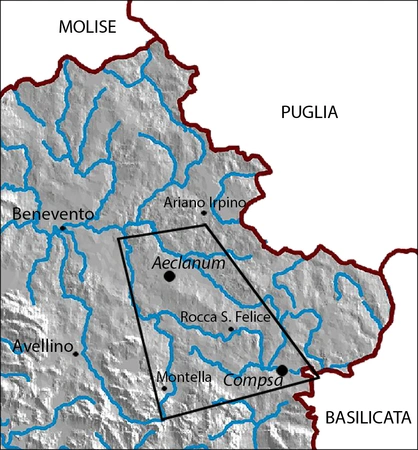
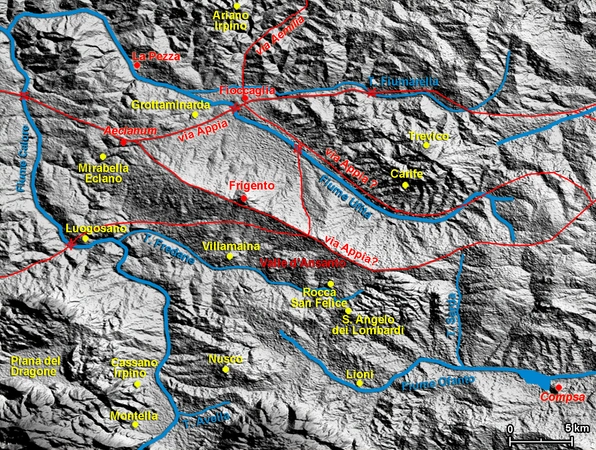
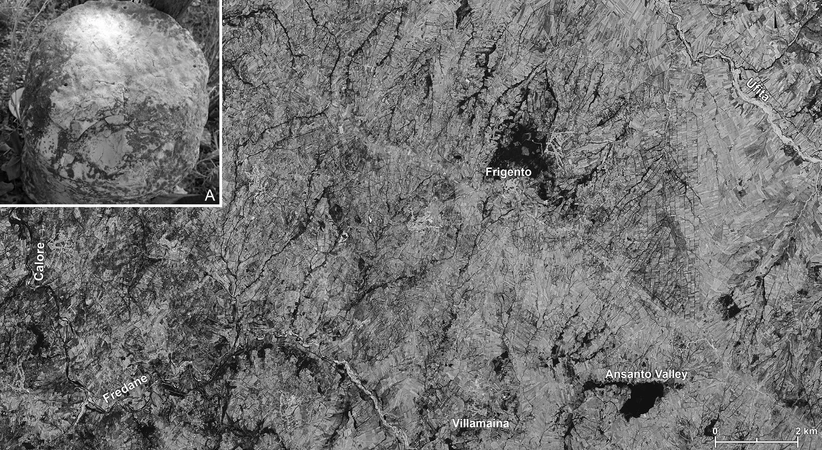
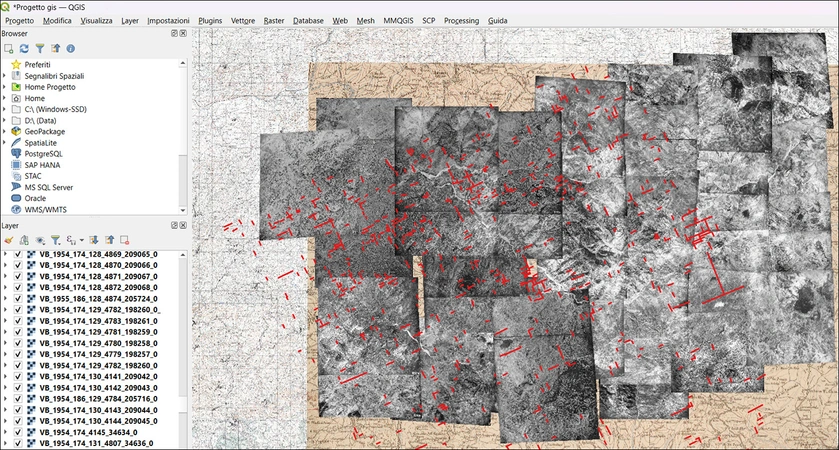
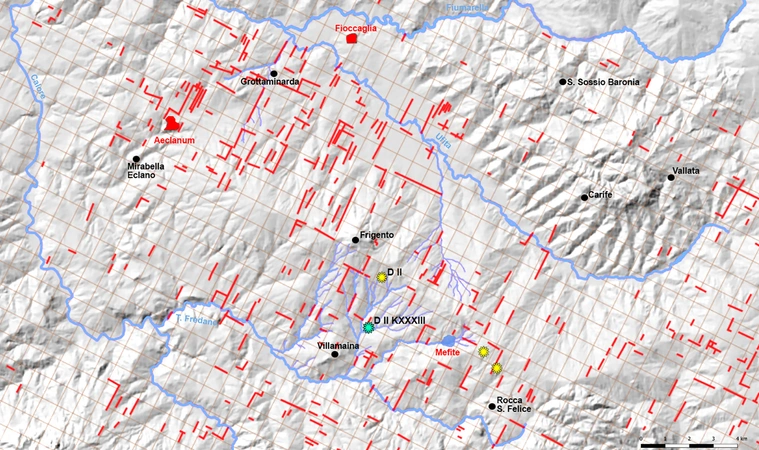
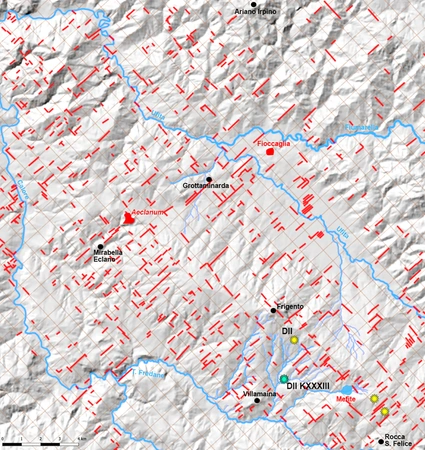
The case study identified in Eastern Irpinia includes the territories belonging to the colony of Aeclanum, to the N, and ancient Compsa, to the S. It is a vast area bordered by the Calore River to the W, which reaches and exceeds the banks of the Ufita River to the E. It offers the opportunity to study a territory that has been little explored in relation to the topic of agrarian divisions, likely due to its decidedly complex geomorphological nature, characterized by a predominantly hilly landscape and rich hydrography, with limited plains. Furthermore, the historical interpretation of the entire territory is equally complex, for which the boundaries of each center can only be hypothesized. Following the indications of the Liber Coloniarum, which mentions divisions for both Aeclanum and Compsa, and considering the discovery of eight agrarian division stones, of which at least 6 dating to Gracchan period, an attempt is being made to reconstruct the agrarian divisions implemented in the territory through the analysis of historical cartography, aerial photographs and with the aid of machine-learning applications starting from high-resolution satellite images.
Figures
Preview
Subjects:
Remote Sensing Survey and excavations
Download (PDF)Publishers:
CNR - Istituto di Scienze del Patrimonio Culturale
Edizioni All'Insegna del Giglio
This website uses only technical cookies strictly necessary for its proper functioning. It doesn't perform any profiling and doesn't use third party cookies of any kind.
Read our privacy policy for additional information.
By clicking 'OK' or closing this banner you acknowledge having read this information and accept the website's contents.