

Marcato P., Siena S. 2025, Populating Byzantine Southern Italy: un geodatabase archeologico e antropologico per lo studio demografico dell’età bizantina, «Archeologia e Calcolatori», 36.1, 29-46 (https://doi.org/10.19282/ac.36.1.2025.02)
Copy to clipboard Download: BibTeXPopulating Byzantine Southern Italy: un geodatabase archeologico e antropologico per lo studio demografico dell’età bizantina
«Archeologia e Calcolatori» 2025, 36.1, 29-46; doi: 10.19282/ac.36.1.2025.02
Abstract
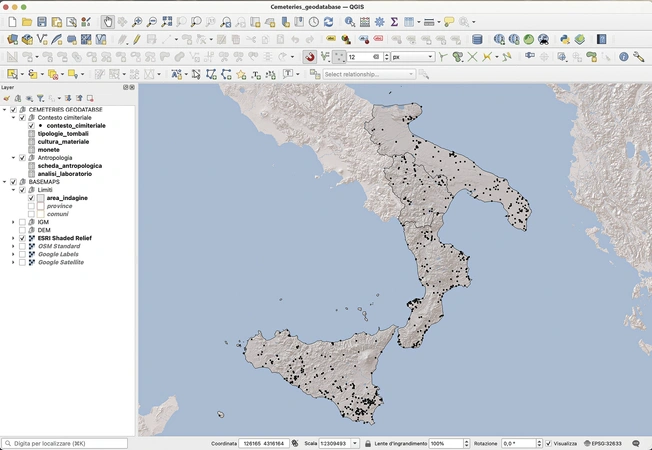
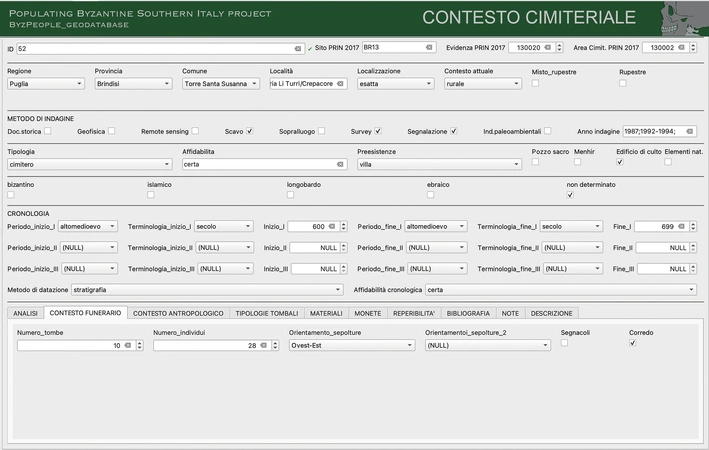
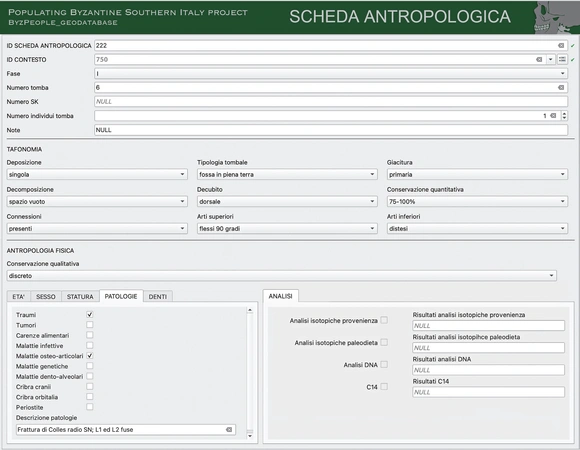
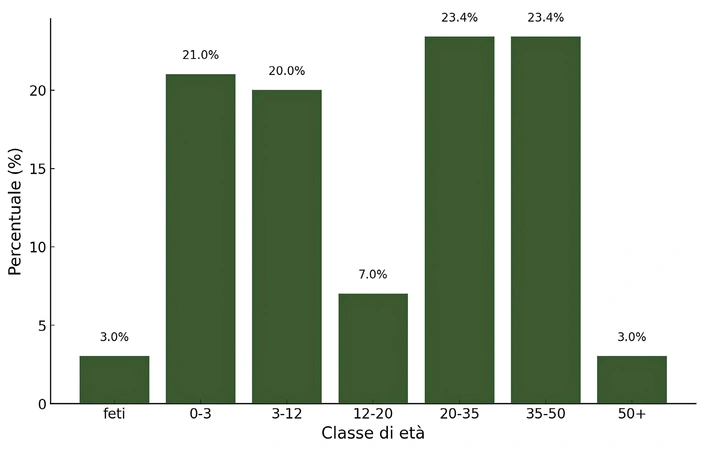
This paper presents the geodatabase developed within the ‘Populating Byzantine Southern Italy project’, with the aim of systematically cataloguing the cemetery contexts, anthropological data, and scientific analyses carried out on individuals who died in Southern Italy during the Byzantine period. This tool enables the integration of anthropological, isotopic, genetic and archaeological data to deepen the understanding of settlement dynamics, mobility, and funerary practices. The relational structure of the geodatabase is described, strengthened by the use of standardized vocabularies to ensure consistency and reliability in data entry. Additionally, its integration with the geodatabase of the ‘Byzantine Heritage of Southern Italy project’ allows for interaction with other ‘global’ archaeological information on the territory and period under examination. Preliminary results from the catalogued data reveal a significant demographic complexity, but also highlight the current scarcity of available information. In conclusion, the paper advocates for greater attention from researchers to anthropological data and underscores the importance of initiatives aimed at data sharing.
Figures
Preview
References
Click on the reference to open it in Bi.Di.Ar. (Bibliography of Digital Archaeology)
- Arthur P. 2007, Pots and boundaries. On cultural and economic areas between late antiquity and the early middle ages, in M. Bonifay, J.-C. Treglia (eds.), LRCW2. Late Roman Coarse Wares, Cooking Wares and Amphorae in the Mediterranean: Archaeology and Archaeometry, Oxford, Archaeopress, 15-28.
- Arthur P. 2010, Riflessioni intorno alla produzione e circolazione della ceramica nel basso adriatico, in S. Menchelli, S. Santoro Bianchi, M. Pasquinucci, G. Guiducci (eds.), LRCW3 Late Roman Coarse Wares, Cooking Wares and Amphorae in the Mediterranean Archaeology and Archaeometry, Oxford, Archaeopress, 79-88.
- Arthur P. 2012, From Italy to the Aegean and back. Notes on the archaeology of Byzantine maritime trade, in S. Gelichi, R. Hodges (eds.), One Sea to Another. Trading Places in the European and Mediterranean Early Middle Ages, Turnhout, Brepols, 337-352 (https://doi.org/10.1484/m.scisam-eb.1.101098).
- Arthur P. 2018, Byzantine “Globular amphorae” and the early middle ages: Attempting to shed light on a dark-age enigma, «Archeologia Medievale», 45, 281-288.
- Arthur P., Calcagnile L., Bruno B., Quarta G., D’Elia M. 2007, Sepolture multiple e datazioni al radiocarbonio ad alta risoluzione di resti osteologici provenienti dal villaggio di Quattro Macine, Giuggianello (LE), «Archeologia Medievale», 34, 297-301.
- Arthur P., Leo Imperiale M., Muci G. 2018, Amphoras, networks, and Byzantine maritime trade, in J. Leidwanger, C. Knappett (eds.), Maritime Networks in the Ancient Mediterranean World, Cambridge, Cambridge University Press, 219-237.
- Baker B.J., Agarwal S.C. 2017, Stronger together: Advancing a global bioarchaeology, «Bioarchaeology International», 1, 1-2, 1-18 (https://doi.org/10.5744/bi.2017.1005).
- Barbanera M., Carusa A., Nicolari R. (eds.) 2023, Diaspora. Migrazioni, incontri e trasformazioni nel Mediterraneo antico, Roma, Quasar.
- Barbiera I. 2008, Il mistero delle donne scomparse. Sex-ratio e società nel medioevo italiano, «Archeologia Medievale», 35, 491-501.
- Barbiera I. 2018, Sex-ratio nell’Italia medievale: accesso conteso alle risorse?, in S. Joye, R. Le Jan (eds.), Genre et compétition dans les sociétés occidentales du haut moyen âge (IVe-XIe siècle), Turnhout, Brepols, 43-63 (https://doi.org/10.1484/m.hama-eb.5.114108).
- Barbiera I., Dalla Zuanna G. 2007, Le dinamiche della popolazione nell’Italia medievale. Nuovi riscontri su documenti e reperti archeologici, «Archeologia Medievale», 34, 19-42.
- Berzellini B., Marinato M., Piragnolo M. 2024, Un database condiviso ad accesso libero per lo studio archeologico dei cimiteri medievali in Italia settentrionale, «Archeologia e Calcolatori», 35, 1, 233-250 (https://doi.org/10.19282/ac.35.1.2024.16).
- Buckberry J. 2000, Missing, presumed buried? Bone diagenesis and the under-representation of Anglo-Saxon children, «Assemblage», 5, 1-14 (http://hdl.handle.net/10454/676).
- Caminneci V., Rizzo M.S., Carver M.O.H. 2024, Burial rites in Byzantine Sicilia. New approaches and discoveries, in A. Dolea, L. Lavan (eds.), Burial and Memorial in Late Antiquity. Volume 2: Regional Perspectives, Leiden-Boston, Brill, 727-751 (https://doi.org/10.1163/9789004687974_010).
- Chamberlain A.T. 2006, Demography in Archaeology, Cambridge, Cambridge University Press.
- Chavarría Arnau A. 2018, People and landscapes in Northern Italy: Interrogating the burial evidence, in P. Diarte, N. Christie (eds.), Interpreting the Transformations of People and Landscapes in Late Antiquity and the Middle Ages, Oxford, Oxbow Books, 163-178.
- Chavarría Arnau A., Lamanna L., Marinato M. 2024, Recent bioarchaeological research on early medieval cemeteries in Italy, in L. Lavan (ed.), Burial and Memorial in Late Antiquity. Volume 1: Thematic Perspectives, Leiden-Boston, Brill, 23-40 (https://doi.org/10.1163/9789004687981_003).
- Cocozza C., Teegen W.-R., Vigliarolo I., Favia P., Giuliani R., Muntoni I.M., Oione D., Clemens L., Groß M., Roberts P., Lubritto C., Fernandes R. 2023, A Bayesian multi-proxy contribution to the socioeconomic, political, and cultural history of late medieval Capitanata (Southern Italy), «Scientific Reports», 13 (https://doi.org/10.1038/s41598-023-30706-9).
- Cosentino S. 2022, Pillars of empire. The economic role of the large islands of the Mediterranean from late antiquity to the early middle ages, «Dumbarton Oaks Papers», 76, 245-280.
- Djurić M., Djurić K., Milovanović P., Janović A. 2011, Representing children in excavated cemeteries: The intrinsic preservation factors, «Antiquity», 85, 327, 250-262 (https://doi.org/10.1017/S0003598X00067582).
- Fenton T.W., Hurst C.V., Vollner J. 2015, L’analisi dei resti scheletrici umani, in P. Arthur, M. Leo Imperiale, M. Tinelli (eds.), Apigliano. Un villaggio bizantino e medievale in Terra d’Otranto. I reperti, Galatina, Università del Salento, 115-120.
- Filzwieser R., Eichert S. 2020, Towards an online database for archaeological landscapes. Using the web based, open source software open atlas for the acquisition, analysis and dissemination of archaeological and historical data on a landscape basis, «Heritage», 3, 1385-1401 (https://doi.org/10.3390/heritage3040077).
- Fornaciari G. 1980, Considerazioni antropologiche e paleopatologiche sugli inumati del “chiostro piccolo” di Santa Maria all’Impruneta (Firenze, metà sec. XV), «Quaderni di Scienze Antropologiche», 4, 78-93.
- Francesco F., Cilli E., Arena F., Sarno S., Modi A., De Fanti S., Andrews A.J., Latorre A., Abondio P., Larocca F., Lari M., Caramelli D., Gualdi-Russo E., Luiselli D. 2021, First Bronze age human mitogenomes from Calabria (Grotta Della Monaca, Southern Italy), «Genes», 12, 636 (https://doi.org/10.3390/genes12050636).
- Giannecchini M., Moggi-Cecchi J. 2008, Stature in archeological samples from central Italy: Methodological issues and diachronic changes, «American Journal of Physical Anthropology», 135, 3, 284-292 (https://doi.org/10.1002/ajpa.20742).
- Giostra C. (ed.) 2019, Migrazioni, clan, culture: archeologia, genetica e isotopi stabili, Archeologia Barbarica 3, Mantova, SAP Società Archeologica.
- Giovannini F. 2001, Natalità, mortalità e demografia dell’Italia medievale sulla base di dati archeologici, Oxford, Archaeopress (https://doi.org/10.30861/9781841711775).
- Horden P., Purcell N. 2000, The Corrupting Sea, London, Blackwell.
- Izdebski A., Preiser-Kapeller J. 2024, A Companion to the Environmental History of Byzantium, Leiden-Boston, Brill (https://doi.org/10.1163/9789004689350).
- Lazaridis I., Nadel D., Rollefson G. et al. 2016, Genomic insights into the origin of farming in the ancient Near East, «Nature», 536, 7617, 419-424 (https://doi.org/10.1038/nature19310).
- Leo Imperiale M. 2018, Anfore e reti commerciali nel basso Adriatico tra VIII e XII secolo, «Archeologia Medievale», 45, 47-64.
- Mallegni F., Paglialunga L., Ronco D., Vitiello A. 1994, Su una sepoltura collettiva di bambini di epoca tardo medievale rinvenuta durante lo scavo archeologico di Piazza Dante a Pisa, «Rivista di Antropologia», 72, 119-134.
- Manifold B.M. 2010, The representation of non-adult skeletal elements recovered from british archaeological sites, «Childhood in the Past», 3, 43-62 (https://doi.org/10.1179/cip.2010.3.1.43).
- Marcato P. 2024, La frontiera di Bisanzio: verso una caratterizzazione dell’Italia meridionale tra VI e XI secolo. Networks e collegamenti marittimi, Tesi di Dottorato, Università del Salento.
- Marcato P., Alfarano S. 2025, Per un database dell’Italia meridionale bizantina, in Atti del Convegno Internazionale di Studi L’Italia Meridionale nel Medioevo. Un centro politico, culturale ed economico (secoli V-XIII) (Amalfi 2021), Amalfi, Centro di Cultura e Storia Amalfitana.
- Marcato P. c.s., I sistemi GIS e webGIS del progetto “Byzantine Heritage of Southern Italy”, in Atti del Convegno Internazionale Byzantine Heritage of Southern Italy (Lecce 2024).
- Marinato M. 2019, Alimentazione, salute e mobilità della popolazione in Italia settentrionale tra IV e VIII secolo. Approcci bioarcheologici, Mantova, SAP Società Archeologica.
- Mathieson I., Alpaslan-Roodenberg S., Posth C. et al. 2018, The genomic history of southeastern Europe, «Nature», 555, 197-203 (https://doi.org/10.1038/nature25778).
- McCormick M. 2001, Origins of the European economy: Communications and commerce, A.D. 300-900, Cambridge-New York, Cambridge University Press.
- Meneghello L. 1989, Perizia antropologica su numerosi resti scheletrici di neonati rinvenuti nelle località di San Zeno e Mezzocorona (Trento) e databili al IV-V sec. d.C., «Quaderni di Scienze Antropologiche», 15, 21-24.
- Rolandsen G.L., Arthur P., Alexander M.A. 2019, A tale of two villages: Isotopic insight into diet, economy, cultural diversity and agrarian communities in medieval (11th-15th century CE) Apulia, Southern Italy, «Journal of Archaeological Science: Reports», 28, 102009 (https://doi.org/10.1016/j.jasrep.2019.102009).
- Sarno S., Boattini A., Pagani L., Sazzini M., De Fanti S., Quagliarello A., Gnecchi-Ruscone G.A., Guichard E., Ciani G., Bortolini E., Barbieri C., Cilli E., Petrilli R., Mikerezi I., Sìneo L., Vilar M.G., Wells S., Luiselli D., Pettener D. 2021, Ancient and recent admixture layers in Sicily and Southern Italy trace multiple migration routes along the Mediterranean, «Scientific Reports», 7 (https://doi.org/10.1038/s41598-017-01802-4).
- Semple S., Brookes S. 2020, Necrogeography and necroscapes: Living with the dead, «World Archaeology», 52, 1, 1-15 (https://doi.org/10.1080/00438243.2020.1779434).
- Soren D., Fenton T.W., Birkby W. 1995, The late Roman infant cemetery near Lugnano in Teverina, Italy: Some implications, «Journal of Paleopathology», 7, 1, 13-42.
- Tofanelli S., Brisighelli F., Anagnostou P., Busby G.B.J., Ferri G., Thomas M.G., Taglioli L., Rudan I., Zemunik T., Hayward C., Bolnick D.A., Romano V., Calì F., Luiselli D., Shepherd G., Tusa S., Facella A., Capelli C. 2015, The Greeks in the West: Genetic signatures of the Hellenic colonisation in Southern Italy and Sicily, «European Journal of Human Genetics», 24, 429-436 (https://doi.org/10.1038/ejhg.2015.124).
- Ubelaker D.H. 2006, The changing role of skeletal biology at the Smithsonian, in J.E. Buikstra, L.A. Beck (eds.), Bioarchaeology. The Contextual Analysis of Human Remains, Amsterdam-Boston, Academic Press, 73-81.
- Ughi A. 2021, Diet in Transition. Stable Isotope Analysis of Multi-Faith Populations in Medieval Sicily, PhD Thesis, University of York.
- Walker P.L., Johnson J.R., Lambert P.M. 1988, Age and sex biases in the preservation of human skeletal remains, «American Journal of Physical Anthropology», 76, 183-188 (https://doi.org/10.1002/ajpa.1330760206).
- Zavagno L. 2020, “No Island is an Island”: The Byzantine Mediterranean in the early middle ages (600s-850s), «The Legends Journal of European History Studies», 1, 57-80 (https://doi.org/10.29228/legends.44375).
Browse
Subjects
Database Classification of archaeological finds
Download (PDF)Publishers
CNR - Istituto di Scienze del Patrimonio Culturale
Edizioni All'Insegna del Giglio
Places mentioned in the article
This website uses only technical cookies strictly necessary for its proper functioning. It doesn't perform any profiling and doesn't use third party cookies of any kind.
Read our privacy policy for additional information.
By clicking 'OK' or closing this banner you acknowledge having read this information and accept the website's contents.