

Padovani C. 2025, Kiln Database (KDB) Project. Creating knowledge on ancient Southwest Asia pottery firing technology: theoretical and methodological problems, «Archeologia e Calcolatori», 36.1, 9-28 (https://doi.org/10.19282/ac.36.1.2025.01)
Copy to clipboard Download: BibTeXKiln Database (KDB) Project. Creating knowledge on ancient Southwest Asia pottery firing technology: theoretical and methodological problems
«Archeologia e Calcolatori» 2025, 36.1, 9-28; doi: 10.19282/ac.36.1.2025.01
Abstract
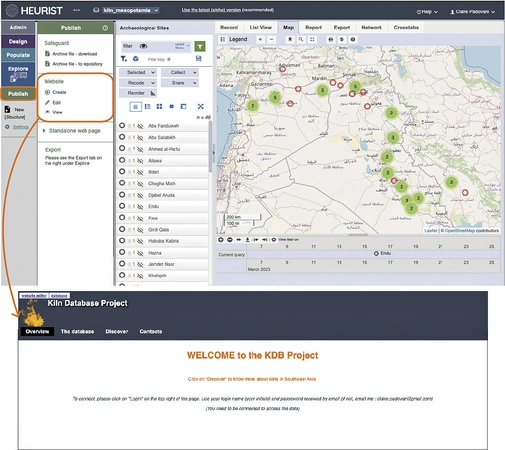
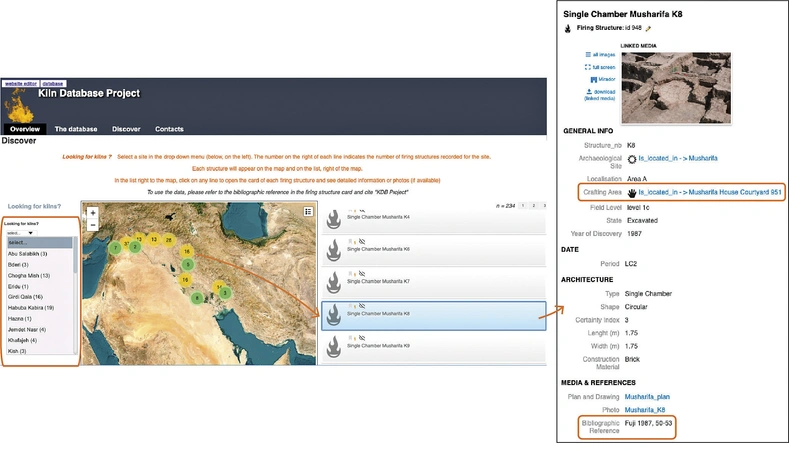
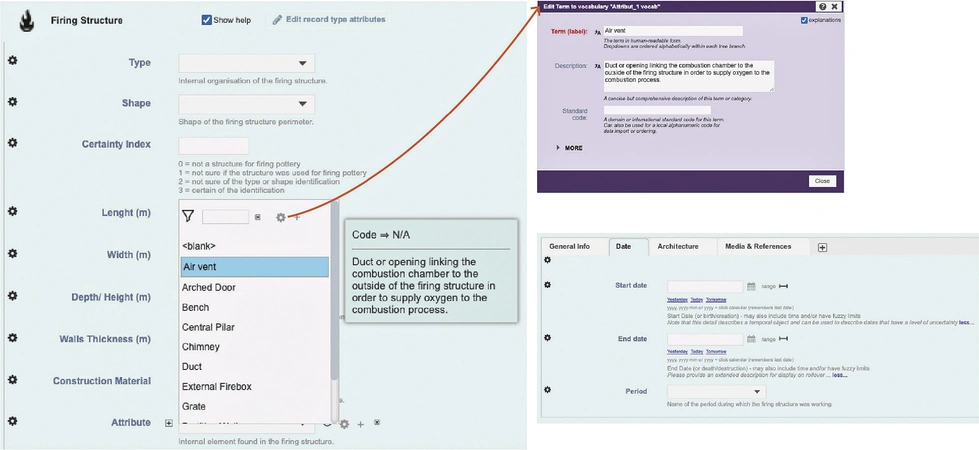
In actual archaeological projects, there is a push towards embracing open science principles, which involves the transparent sharing of raw data and research protocols to facilitate knowledge dissemination. This emulation fosters technical innovation in the field of software development applied to archaeology, to diffuse large amount of data. However, implementing open science effectively poses significant theoretical challenges to consider when selecting a technical solution. This paper investigates the historiography of pottery kiln research - a field that remains relatively underdocumented - to identify inherent biases in the construction of knowledge, in order to guide the creation of a sustainable and widely accessible body of knowledge on the subject. It details the systemic conceptual framework, decision-making process, and technical implementation of an open-access database designed to record data on pyrotechnology and related archaeological contexts, thereby facilitating comparative analysis and identification of firing structures on the field. Although the database is currently in an early stage of development, it is essential to critically assess theoretical and methodological project requirements, consider how data structuring shape knowledge, and ensure that the chosen software infrastructure aligns with the FAIR and CARE principles, to achieve in the near future, the creation of a robust and enduring data repository.
Figures
Preview
References
Click on the reference to open it in Bi.Di.Ar. (Bibliography of Digital Archaeology)
- Ackoff R.L. 1989, From data to wisdom, «Journal of Applied Systems Analysis», 15, 3-9.
- Anderson C. 2008, The end of theory: The data deluge makes the scientific method obsolete, «Wired», 16, 7 (https://www.wired.com/2008/06/pb-theory/).
- Arnold D. 1985, Ceramic Theory and Cultural Process, New Studies in Archaeology, Cambridge, Cambridge University Press.
- Binford L.R. 1964, A consideration of archaeological research design, «American Antiquity», 29, 425-441 (https://doi.org/10.2307/277978).
- Binford S.R., Binford L.R. (eds.) 1968, New Perspectives in Archaeology, Chicago, Aldine.
- Bollier D. 2010, The Promise and Peril of Big Data, Washington DC, The Aspen Institute.
- Boroffka N., Becker J.A. 2004, Töpferöfen un Arisman, in T. Stöllner, R. Slotta, A. Vatandoust (eds.), Persiens Antike Pracht, Bochum, Deutsches Bergbau-Museum Bochum, 218-221.
- Carroll S.R., Garba I., Figueroa-Rodriguez O., Holbrook J., Lovett R., Materechera S., Parsons M., Raseroka K., Rodriguez-Lonebear D., Rowe R., Sara R., Walker J.L., Anderson J.A., Hudson M. 2020, The CARE principles for indigenous data governance, «Data Science Journal», 19, 1-12 (https://doi.org/10.5334/dsj-2020-043).
- Carroll S.R., Rodriguez-Lonebear D., Martinez A. 2019, Indigenous data governance: Strategies from United States native nations, «Data Science Journal», 18, 31, 1-15 (https://doi.org/10.5334/dsj-2019-031).
- Chevalier N. 2002, La recherche archéologique française au Moyen-Orient 1842-1947, Paris, Editions Recherche sur les Civilisations.
- Clarke D.L. 1968, Analytical Archaeology, London, Methuen.
- Clarke D.L. 1973, Archaeology: The loss of innocence, «Antiquity», 47, 185, 6-18 (https://doi.org/10.1017/S0003598X0003461X).
- Delcroix G., Huot J.-L. 1972, Les fours dits de potier dans l’Orient ancien, «Syria», 49, 1-2, 35-95 (https://doi.org/10.3406/syria.1972.6331).
- Gallay A. 1977, A propos de deux banques de données sur ordinateur en archéologie, «Archives suisses d’anthropologie générale», 41, 2, 99-110.
- Gallay A. 1989, Logicism: A French view of archaeological theory founded in computational perspective, «Antiquity», 63, 27-39 (https://doi.org/10.1017/S0003598X00075554).
- Gardin J.-C. 1958, Four codes for the description of artifacts: An essay in archaeological technique and theory, «American Anthropologist», 60, 2, 335-357 (https://doi.org/10.1525/aa.1958.60.2.02a00090).
- Gardin J.-C. 1959, On the coding of geometrical shapes and other representations, with reference to archaeological documents, in Proceedings of the International Conference on Scientific Information (Washington, D.C. 1958), Washington, D.C., National Academy of Sciences, 107-124 (https://nap.nationalacademies.org/read/10866/chapter/60).
- Gardin J.-C. 1962, Documentation sur cartes perforées en travaux sur ordinateur dans les sciences humaines, «Revue internationale de la documentation», 29, 83-92.
- Gardin J.-C. 1962, La syntaxe dans les langages documentaires, «Information Retrieval», 1-7.
- Gardin J.-C. 1970, UNISIST: étude sur la réalisation d’un système mondial d’information scientifique, Paris, UNESCO.
- Gardin J.-C. 1979, Une archéologie théorique, L’Esprit critique, Paris, Hachette.
- Gardin J.-C. 1987, Questions d’épistémologie pratique dans les perspectives de l’intelligence artificielle, «Bulletin de la Société française de Philosophie», 81, 3, 69-112.
- Garstki K. 2024, Digital archaeology, in E. Nikita, T. Rehren (eds.), Encyclopedia of Archaeology, 1, (2nd ed), London, Academic Press, 245-252 (https://doi.org/10.1016/b978-0-323-90799-6.00176-2).
- Ghirshman R. 1938, Fouilles de Sialk près de Kashan 1933, 1934, 1937, 1, Série Archéologique 4, Paris, Musée du Louvre.
- González-Pérez C. 2018, Information Modelling for Archaeology and Anthropology: Software Engineering Principles for Cultural Heritage, Cham, Springer.
- Gosselain O.P. 1992, Bonfire of the enquiries. Pottery firing temperature in archaeology: What for?, «Journal of Archaeological Science», 19, 243-259 (https://doi.org/10.1016/03054403(92)90014-T).
- Hamilakis Y. 2003, Iraq, stewardship and “the record”: An ethical crisis for archaeology, «Public Archaeology», 3, 104-111 (https://doi.org/10.1179/pua.2003.3.2.104).
- Hansen Streily A. 2000, Early pottery kilns in the Middle East, «Paléorient», 26, 2, 69-82 (https://doi.org/10.3406/paleo.2000.4711).
- Kukutai T., Taylor J. 2016, Indigenous Data Sovereignty: Toward an Agenda, Canberra, Australian National University.
- Kukutai T., Walter M. 2015, Recognition and indigenizing official statistics: Reflections from Aotearoa New Zealand and Australia, «Statistical Journal of the IAOS», 31, 2, 317-326 (https://doi.org/10.3233/sji-150896).
- Livingstone Smith A. 2001, Bonfire II: The return of pottery firing temperature, «Journal of Archaeological Science», 28, 9, 991-1003 (https://doi.org/10.1006/jasc.2001.0713).
- Majidzadeh Y. 1975, The development of the pottery kiln in Iran from prehistoric to historical periods, «Paléorient», 3, 207-221 (https://doi.org/10.3406/paleo.1975.4197).
- Matson F.R. 1974, The archaeological present: Near eastern village potters at work, «American Journal of Archaeology», 78, 4, 345-347 (https://doi.org/10.2307/502748).
- Meadow R.H. 1991, Harappa Excavations 1986-1990: A Multidisciplinary Approach to Third Millenium Urbanism, Monographs in World Archaeology 3, Madison, Prehistory Press.
- Moscati P. 2021, Digital archaeology: From interdisciplinarity to the “fusion” of core competences. Towards the consolidation of new research areas, «magazén», 2, 2, 253-274 (https://doi.org/10.30687/mag/2724-3923/2021/04/004).
- Moscati P. (ed.) 2019, 30 anni di “Archeologia e Calcolatori”. Tra memoria e progettualità, «Archeologia e Calcolatori», 30 (https://www.archcalc.cnr.it/journal/volumes/30/0#30-anni-di-archeologia-e-calcolatori-tra-memoria-e-progettualita).
- Padovani C. 2023, Kilns and potters: Measuring pyrotechnology diversity to assess dynamics of firing techniques diffusion within Southwest Asia communities, 6500-4700 BCE, «Journal of Archaeological Science: Reports», 52 (https://doi.org/10.1016/j.jasrep.2023.104273).
- Padovani C. 2023, Kiln technology and potters’ agency in the Early Bronze Age: The social construct of Logardan firing areas, Western Qara Dagh, in N. Marchetti, M. Campeggi, F. Cavaliere, C. D’Orazio, G. Giacosa, E. Mariani (eds.), Field Reports. Environmental Archaeology. Hammering the Material Word. Proceedings of the 12th International Congress on the Archaeology of the Ancient Near East (Bologna 2021), Wiesbaden, Harrassowitz Verlag, 475-490 (https://doi.org/10.13173/9783447118736.475).
- Padovani C. 2023, L’organisation de la production céramique des premières sociétés urbaines. Analyse technique et sociale des pyrotechnologies et des espaces de travail potiers de l’Asie du Sud-Ouest (4e et 3e millénaires av. n. è.), Thèse, Université Paris 1 Panthéon-Sorbonne.
- Padovani C. 2024, Revisiting kilns typologies to reconstruct firing traditions transformations. A comparative analysis of Halaf and Ubaid kilns in context, «Paléorient», 50, 125-142 (https://doi.org/10.4000/12ugw).
- Porter B.W. 2010, Near Eastern archaeology: Imperial pasts, postcolonial presents, and the possibilities of a decolonized future, in J. Lydon, U. Rizvi (eds.), The World Archaeological Congress Handbook on Postcolonialism and Archaeology, Walnut Creek, Left Coast Press, 49-57.
- Postgate J.N. 1983, The West Mound Surface Clearance, London, British School of Archaeology in Iraq.
- Rehder J.E. 2000, Mastery and Uses of Fire in Antiquity, Montreal, McGill-Queen’s University Press.
- Renfrew J.M. 1969, The archaeological evidence for the domestication of plants: Methods and problems, in P.J. Ucko, G.W. Dimbleby (eds.), The Domestication of Plants and Animals, London, Duckworth, 149-172.
- Roberts B.W., Radivojevic M. 2015, Invention as a process: Pyrotechnologies in early societies, «Cambridge Archaeological Journal», 25, 1, 299-306 (https://doi.org/10.1017/S0959774314001188).
- Rye O.S., Evans C. 1976, Traditional Pottery Techniques of Pakistan: Field and Laboratory Studies, Washington, Smithsonian Institution Press.
- Schiffer M.B. 2010, Behavioral Archaeology: Principles and Practices, London, Equinox.
- Simondon G. 1958, Du mode d’existence des objets techniques, Paris, Aubier.
- Smith L.T. 2012, Decolonizing Methodologies: Research and Indigenous Peoples, London, University of Otago Press.
- Wilkinson M.D., Dumontier M., Aalbersberg Ij.J. et al. 2016, The FAIR Guiding Principles for scientific data management and stewardship, «Scientific Data», 3, 1, 160018 (https://doi.org/10.1038/sdata.2016.18).
Browse
Subjects
Database Classification of archaeological finds
Download (PDF)Publishers
CNR - Istituto di Scienze del Patrimonio Culturale
Edizioni All'Insegna del Giglio
Places mentioned in the article
This website uses only technical cookies strictly necessary for its proper functioning. It doesn't perform any profiling and doesn't use third party cookies of any kind.
Read our privacy policy for additional information.
By clicking 'OK' or closing this banner you acknowledge having read this information and accept the website's contents.