
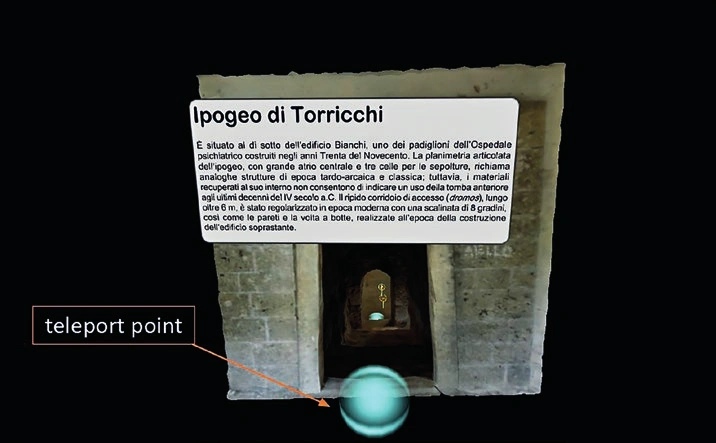
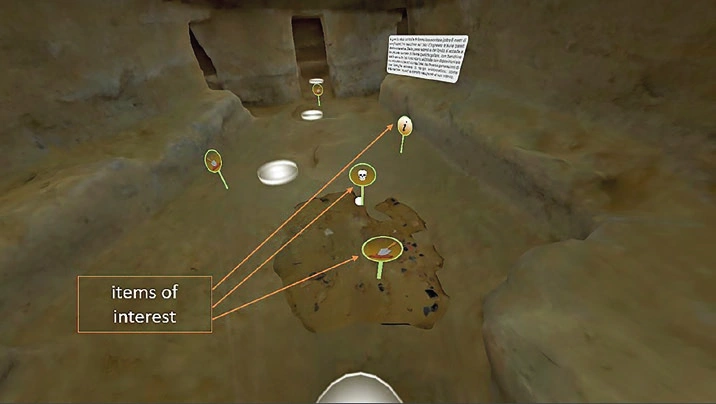
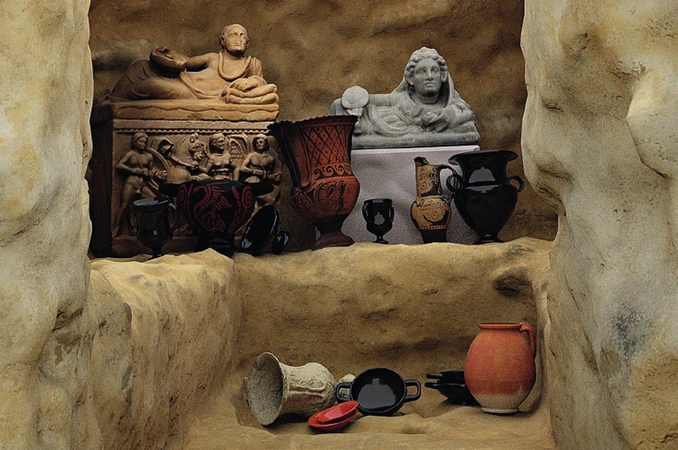

Taccola E., Rosselli L., Albertini N., Martino M. 2021, Etruscan hypogea in 3D: a proposal for an immersive and interactive visualization of Volterra’s funerary contexts, in V. Baldoni (ed.), From pottery to context. Archaeology and virtual modelling, «Archeologia e Calcolatori», 32.2, 135-152 (https://doi.org/10.19282/ac.32.2.2021.12)
Copy to clipboard Download: BibTeXEtruscan hypogea in 3D: a proposal for an immersive and interactive visualization of Volterra’s funerary contexts
Emanuele Taccola, Lisa Rosselli, Nicolò Albertini, Marta Martino
«Archeologia e Calcolatori» 2021, 32.2, 135-152; doi: 10.19282/ac.32.2.2021.12
Abstract
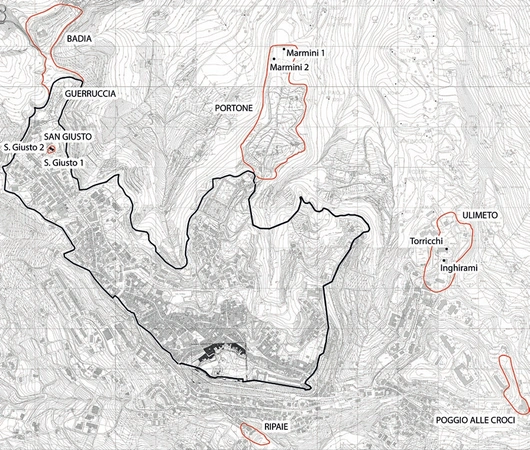
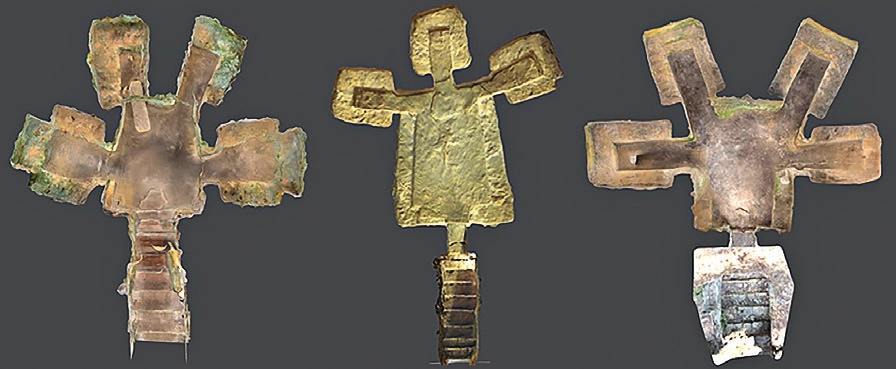
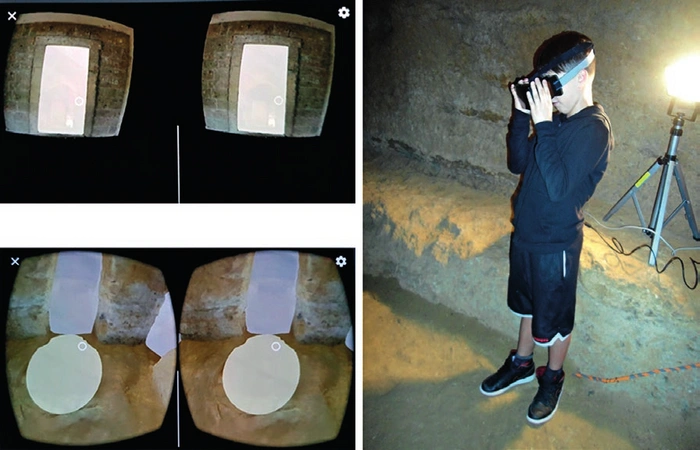
This article describes an interdisciplinary study carried out by a team of archaeologists, 3D surveyors and experts of new technologies applied to cultural heritage. The research was aimed at developing a virtual reality experience dedicated to Etruscan hypogean tombs in the city of Volterra. The application, intended for non-expert users, has been implemented in a touch screen version (mobile devices) as well as in VR mode (Samsung Gear Headset). In both versions, the user can easily interact with the immersive virtual context, browsing through the necropolises and/or underground tombs, and acquire textual and multimedia information.
Figures
3D Models
Preview
References
Click on the reference to open it in Bi.Di.Ar. (Bibliography of Digital Archaeology)
- Albertini N., Baldini J., Taccola E. 2017, New methods of interaction in virtual reality for the study of archaeological data, in The Asian Conference on Arts & Humanities. Official Conference Proceedings (Kobe 2017), Nagoya (Japan), The International Academic Forum, 101-111.
- Albertini N., Barone V., Legnaioli S., Licari S., Taccola E., Brogni A. 2014, The agora of Segesta in immersive virtual environments, in Proceeding of the 6th International Congress “Science and Technology for the Safeguard of Cultural Heritage in the Mediterranean Basin” (Athens 2013), 1, Roma, Valmar, 299-304.
- Albertini N., Brogni A., Caramiaux B., Gillies M., Olivito R., Taccola E. 2016, Natural gesture interaction in archaeological virtual environments: Work in progress, in J.L. Lerma, M. Cabrelles (eds.), ARQUEOLÓGICA 2.0. 8th International Congress on Archaeology, Computer Graphics, Cultural Heritage and Innovation (Valencia 2016), Valencia, Editorial Universitat Politècnica de València, 284-287.
- Albertini N., Brogni A., Caramiaux B., Gillies M., Olivito R., Taccola E. 2017, Designing natural gesture interaction for archaeological data in immersive environments, «Virtual Archaeology Review», 8, 16, 12-21.
- Barceló J.A. 2001, Virtual reality for archaeological explanation. Beyond “picturesque” reconstruction, «Archeologia e Calcolatori», 12, 221-244 (https://doi.org/10.19282/ac.12.2001.12).
- Bruno F., Bruno S., De Sensi G., Luchi M.-L., Mancuso S., Muzzupappa M. 2010, From 3D reconstruction to virtual reality: A complete methodology for digital archaeological exhibition, «Journal of Cultural Heritage», 11, 1, 42-49 (https://doi.org/10.1016/j.culher.2009.02.006).
- Cristofani M. 1973, Tombe ellenistiche nella necropoli del Portone (scavi 1970), in Notizie degli Scavi di Antichità. Supplemento, Suppl., 246-272.
- Fiumi E. 1977, La collezione di urne del Museo Guarnacci nel XVIII e XIX secolo, in M. Cristofani (ed.), Corpus delle urne etrusche di età ellenistica 2. Urne volterrane 2. Il Museo Guarnacci, Firenze, Centro Di, 9-20.
- Forte M. 2014, Virtual Reality, cyberarchaeology, teleimmersive archaeology, in S. Campana, F. Remondino (eds.), 3D Recording and Modelling in Archaeology and Cultural Heritage. Theory and Best Practices, BAR International Series 2598, Oxford, Archaeopress, 65-129.
- Minto A. 1930, Le scoperte archeologiche nell’agro volterrano dal 1897 al 1899, «Studi Etruschi», 4, 9-68.
- Olivito R., Taccola E., Albertini N. 2015, A hand-free solution for the interaction in an immersive virtual environment: The case of the agora of Segesta, in 3D-Arch 2015. 3D Virtual Reconstruction and Visualization of Complex Architectures (Avila 2015), «The International Archives of the Photogrammetry, Remote Sensing and Spatial Information Sciences», 31-36.
- Olivito R., Taccola E., Albertini N. 2016, Cultural heritage and digital technologies. Theory, methods and tools for the study and dissemination of knowledge in the archaeological practice, in M. Forte, S. Campana (eds.), Digital Methods and Remote Sensing in Archaeology. Archaeology in the Age of Sensing, Cham, Springer, 475-494.
- Olivito R., Taccola E., Albertini N. 2016, Hand-free interaction in the virtual simulation of the agora of Segesta, in S. Campana, R. Scopigno, G. Carpentiero, M. Cirillo (eds.), Keep the Revolution Going. CAA 2015. Computer Applications and Quantitative Methods in Archaeology. Proceedings of the 48th Conference (Siena 2015), Oxford, Archaeopress, 321-328 (https://doi.org/10.2307/jj.15135955.42).
- Reilly P. 1991, Towards a virtual archaeology, in K. Lockyear, S. Rahtz (eds.), Computer Applications and Quantitative Methods in Archaeology 1990, BAR International Series 565, Oxford, Tempus Reparatum, 133-140 (https://doi.org/10.15496/PUBLIKATION-2621).
- Remondino F. 2014, Photogrammetry: Theory, in S. Campana, F. Remondino (eds.), 3D Recording and Modelling in Archaeology and Cultural Heritage. Theory and Best Practices, BAR International Series 2598, Oxford, Archaeopress, 65-73.
- Rosselli L. 2015, Tra tutela e valorizzazione: Ezio Solaini Ispettore onorario di Volterra, «Quaderni del Laboratorio Universitario Volterrano», 17, 23-29.
- Rosselli L. 2018, La necropoli delle Ripaie di Volterra. Le tombe di età ellenistica e romana, Pisa, Pisa University Press.
- Rosselli L. 2020, L’ipogeo etrusco di Torricchi a Volterra, «Studi Classici e Orientali», 66, 277-299 (https://doi.org/10.12871/978883339362919).
- Taccola E., Olivito R., Albertini N., Baldini J. 2021, Il santuario di Punta Stilo a Kaulonia: creare, analizzare e comunicare il dato archeologico con le moderne tecnologie digitali, in Gli altri Achei: Kaulonia e Terina, contesti e nuovi apporti. Atti del LVII Convegno di Studi sulla Magna Grecia (Taranto, 28-30 settembre 2017), Istituto per la Storia e l’Archeologia della Magna Grecia, 901-920.
- Taccola E., Rosselli L. 2017, Understanding Etruscan art and architecture through 3D modeling: the case of Volterra, in A. Gaucci, S. Garagnani (eds.), Knowledge, Analysis and Innovative Methods for the Study and the Dissemination of Ancient Urban Areas. Proceedings of the KAINUA 2017 International Conference in Honour of Professor Giuseppe Sassatelli’s 70th Birthday (Bologna 2017), «Archeologia e Calcolatori», 28, 2, 243-252 (https://doi.org/10.19282/AC.28.2.2017.18).
Browse
Subjects
Multimedia and web tools Data dissemination and education
Download (PDF)Publishers
CNR - Istituto di Scienze del Patrimonio Culturale
Edizioni All'Insegna del Giglio
Places mentioned in the article
This website uses only technical cookies strictly necessary for its proper functioning. It doesn't perform any profiling and doesn't use third party cookies of any kind.
Read our privacy policy for additional information.
By clicking 'OK' or closing this banner you acknowledge having read this information and accept the website's contents.